Creative differences

If you consider yourself to be a creative person, I am willing to bet you have also found yourself staring so deep into the abyss on enough occasions to either having sat across from a mental health professional at some point in your life, or someone has pointed out to you that maybe that would be a good idea. Regardless, you’ve had a chance to consider whether or not medication is for you. And many of us tend to opt out. We’d rather live with crippling depression, biweekly panic attacks, compulsions and partner-repelling mood swings than potentially lose the one thing that makes our existence make sense; our creativity.

Let me just pause for a second to let you know that I am aware that this is a myth that’s been thoroughly busted. You can read about this and other SSRI related myths by clicking on this sentence.

Still, it’s a very real fear that needs to be acknowledged. If you cannot fathom why, this post is not for you. Go read something else. I can recommend my book. Or, if you have yet to listen to Rob Halford’s autobiography on Audible, you should go do that. It is fantastic.

If you do know what I’m talking about, though, you’d be very interested in what I heard in a podcast I listened to recently… What we (us mental patients of the neuro-spicy kind) mean by creativity in this scenario is not necessarily how it’s perceived by the people prescribing the meds. On the contrary, when we state our fear of losing our creativity as the main reason were so sceptical, they seem to think our meaning is that we’re afraid we’ll lose the ability to think outside the box. I.e. they think that, by creativity, we mean creative thinking, in regards to problem solving.

Whereas most of us mean the ability to create something unique, freely and without template, fuelled only by an inner compulsion to create. Essentially, its our life force; what makes us us.

Perhaps we should’ve used the word imagination instead. But, it’s not on us. As defined in most thesauruses and dictionaries, creativity is “artistic or intellectual inventiveness”. Yet, in a post found on Psychology Today, we see another example of the writer seemingly focussing on the problem solving aspect rather than the imaginative.

I would be remiss if I’d concluded that all mental health professionals are of the same opinion as this single writer and the neurologist from the podcast, but I do think that it’s worth noting that the person being prescribed the medication might not be equally as immersed in the DSM diagnostics sociolect as the person holding the prescription pad.

It is a myth, though. SSRIs or ADHD meds won’t kill your creative ability (although some SSRIs may cause brainfog, but most ADHDers experience that regardless).

Some lyricists may fear that they can only truly write when they’re depressed, because that’s when they’re the most connected to their emotions or whatever. That’s a load of bollocks. You can certainly learn from depressive episodes, but being depressed isn’t going to make you the next Bob Dylan – if that were the case, you could get the same effect from downing a bottle of red. If you’re really talented, though, you don’t need any of that shit – the talent is part of your personality. And, as far as I know, they have yet to make any FDA approved personality altering drug.

There are logical solutions to creative blocks as well – we’re just too impatient to admit it.

That’s it for today. I reckon my next pist might be real morbid. (Or I might go down a panic attack related wormhole, full gonzo).

Either way, see you next Tuesday!

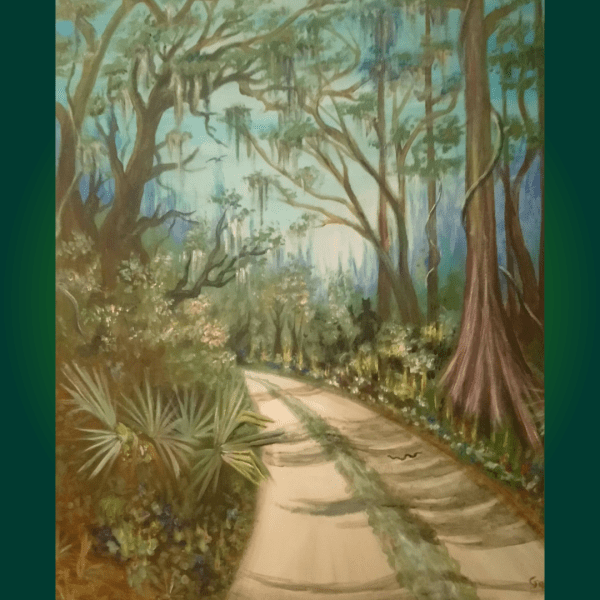
Also, the featured photo is of one of my favourite paintings, ever, found in the Voodoo Museum in New Orleans (quite possibly a Voodoo Charlie original). If you’re ever down NOLA way, you should check it out.

The Power of Luff*

Recently, I was rewatching the first series of Santa Clarita Diet on Netflix (brilliant show, by the way), where the husband, Joel (portrayed by the brilliant Timothy Olyphant), mentions a possible cure for his wife Sheila’s altered, undead, state. Sheila (played by the one and only Drew Barrymore), however, is hesitant, as she is getting so much done, now that she has more energy and needs less sleep. At one point, she even exclaims: “I can parallel park in one move now!”

You might wonder where am I going with this long-winded introduction, other than displaying my love of gore and humour intertwined. Rest assured, I am about to get to the point (rather than rambling on about how I, too, would like to be able to parallel park in one move).

Although I am not undead now that I am medicated (unlike my experience with antidepressants), this really made me think; do I really want to go back to the old me? Can I be successful in life without medication? They’ve had such an immense and immediate effect on me, that I am afraid to go off them. To illustrate:

Within 30 minutes of having taken my first pill, something bizarre happened, in the way I have always imagined an acid dream might feel like. Before this, I would compare my brain to a chaotic second-hand shop, where you really have to dig around to find the good bits. Now, someone had switched on the lights and mister Cerebellum had transmorphed himself into a neat library, with every book and folder in its designated place, on long aisles arranged in alphabetical order. Even my photographic memory – that I thought I’d lost to years of drinking – has started to come back. For me, this was a life-altering experience.

Now, I am not suggesting medication is for anyone – this is about my personal experience, which is why I have excluded the type of medication and whether or not this is the only medication I am on. I am not a medical doctor and do not offer any advice on medication. The featured image is for illustrative purposes only.

Anyway, for someone previously so anti-pharma, this was a point of reckoning for me, that led to some serious soul-searching. I could not discount the effect of the medication, and it helped me focus enough to start and complete three exam papers in as many days. Instead of having to stop and think about everything to remember, I was now able to enter a room and do the thing I had gone in there to do, instead of shaking my head in frustrated confusion as to why I had moved in the first place after crossing the threshold. The song lyrics I’ve written myself, but find so difficult to remember, just poured out of me when the time came to sing them. I stopped doubting myself all of the time. The intrusive images that have haunted me for as long as I can remember were gone. My impulsivity halted and my compulsion to continue drinking or eating when I’d had enough evaporated. This, in turn led to less stress and I started to feel as if I could breathe properly.

Eventually, the effect subsided within a few days and I had to up my dosage to get an effect. The same happened again after another week or so. Then, it just sort of stabilised and the fear set in: Had I imagined the effect out of pure desperation? Would my symptoms come back little by little?

Naturally, I quickly started setting myself up for failure by pushing my boundaries, slowly breaking the new, healthier routines I had adopted, like an obstinate child. I remembered myself elatedly saying that, ‘If this works for only a week, I’ll be grateful to have had that one week where I was normal. Among the living’. Now, the Id had taken over and was on a mission to convince me that I had somehow jinxed myself by uttering those words. Of course, the anxiety caused me to fuck up. I started forgetting things again, struggled to regain focus, let my impulsivity get the better of me.

Although, what I now realise, is that I am still significantly better than I was before I started taking my meds. It is not a placebo. My natural constant hankering for dopamine makes me think that the fact that I don’t have my world turned upside down every time I take a pill, means it’s not working.

Demonstrably, my attention has improved – I am able to focus on everything when needed, not only what I am interested in. I no longer get distracted by the sound of a car driving slowly over rocks on the street outside my window. My working memory has vastly improved. But I am still me; curious, empathetic, caring, fiercely passionate about justice and equally perturbed by injustice.

I might be a bit sensitive-skinned sometimes, or reading too much into things, but at least I now know that that is down to my rejection sensitivity and that I don’t have to walk around thinking that I’ve hurt someone simply because I texted them back ‘OK’ with no emoji. (At least I texted them back, eh?)

I do wonder if I’ll ever feel strong enough to go off the meds, though. In the meantime, I’ll be here, diligently teaching myself new coping mechanisms and preparing for a life in the real world. I will persevere, somehow. I always have done. Will I succeed? That depends on how you define success.

See you next Tuesday.

If you liked my writing and fancy checking out my book, you can head on over to the section where I’ve written all about where you can get a copy – available in paperback and digitally.

If you want to watch something beautiful and thought-provoking, you should check out Sensitive Skin.

For anyone craving a gorgeous listen, you can check out the Gary Numan album I’ve linked to below. Should be played with headphones on, or through proper stereo speakers for max effect. Excellent running music!

*Luff (noun): the act of sailing a ship nearer the wind

Blog at WordPress.com.

Up ↑