Life, anxiety and a “sticky” brain

Before we get started on today’s topic, I just want to give a huge, heartfelt thanks to those of you who continue to find the time in your busy day to read my posts – it really means a lot! If this is your first time on here, you can read my previous posts on the main blog page.

Now, for the subject I had planned on writing about last week; unwanted intrusive thoughts. There seems to be a lot of confusion as to what they actually are and how they can manifest, and I have only recently been made aware of the fact that the term isn’t necessarily restricted to just thoughts and images. They are of course what we normally hear or read about, but that’s not the whole picture – it’s not just random thoughts and images. It can include unwanted sensations, memories and stories as well. Possibly more, I really do not know. But I’ve come across a few interesting perspectives and theories on this subject close to my heart that have made me feel a little more enlightened, that perhaps others can find some comfort in as well. BUT. There is, as always, a big dollop of my opinion in here as well, so take everything I say with a pinch of salt. Especially the part about coding. Anyway, that’s the disclaimer out of the way. On with the show.

It seems to me that referring to these uncontrollable impulses or processes as ‘thoughts’ is not only a gigantic misnomer, but hugely misleading, as the phenomenon can be better described as automatically generated impulses or processes that become unwanted when they feel intrusive in an unnerving way, causing distress and excessive rumination. If the brain was a computer, this process could be compared to a constant generation of possible and/or/not responses to any scenario or eventuality one might run into, where the ‘correct’ response – i.e. the action caused by the prompt – is picked based on true/false Boolean logic. Although I flunked out of computer science quicker than you can say 01001110101 20 years ago, this little part of simple coding somehow stuck with me. It works great for simple processes, but a more complex and unpredictable system just might crash once in a while, or let something inappropriate surface by accident.

What I can gather from most of the articles and research papers I’ve come across so far, is that the experts agree that we all have these concurrent processes going on all of the time – it’s completely natural. Which makes sense. Much like a computer that never switches off or reboots, our brain keeps processing and generating impulses that will keep us from switching off. And, much like when we are in the dream state of sleep, some pretty random stuff can manifest from one of the potential responses generated by some event that perhaps entered our subconscious via an advert, a TV show or something we saw out of the corner of our eye when we weren’t really paying attention, seemingly from out of nowhere. Since we did not interact with this event, in that it did not happen to us directly, our reaction (or response) is not necessarily in line with our conscious thoughts, wants or wishes. Needless to say, your mind suddenly doing something so outlandish to you it seems as if you no longer control your urges or behaviour, it can be a jarring experience.

Imagine, for instance, that you’re having a bad dream because you’ve watched A Nightmare on Elm Street, but instead of being chased by Freddy Krueger… you are the monster killer… only, you’re not asleep in your bed – you’re wide awake and thinking about stabbing the person next to you in the lift to death with a rusty blade. And this urge has made itself known despite your pacifist nature and philanthropic views, yet it feels so real, as if you’ve lost all control of yourself and that your sanity hangs on by a thread. Pretty terrifying, right?

Luckily, for most people, a sudden flash of an alternate reality such as this can be shrugged off as what it is; something bizarre, laughable, that would never, ever happen. But for those of us prone to internalising, overanalysing and rumination? When these unwanted intrusive responses land on our particularly sticky brains, it can become a real problem, sometimes leading to self-deprecating behaviour, negative self-talk and suicidal ideation. If you suffer from anxiety or a personality disorder, you might even convince yourself that this means that this is your ‘true personality’ shining through, and the more you think about it, the harder it seems to stick. I won’t go into specifics here, as to what some people can convince themselves to be capable of – it can be all too triggering.

And why focus on the negative, when there seems to be a universal concurrence among experts, that that is absolutely not the case? I mean, if something seems so foreign to you that you’re practically contorted by feelings of repulsion and anger, it is probably not your second nature. If you were to get a song you really hate stuck on a loop in your head, you wouldn’t think that to mean it was secretly your favourite song, would you?

Then, why can it be so difficult to dismiss these impulses when they occur? My guess would be that our anxiety feeds off of such things and it is far too easy to go into that unhealthy spiral of self-doubt and feelings of unworthiness.

Well, how the fuck can I rid myself of this affliction, then? you may ask.

This is where the experts tend to disagree. (Which is why I’ve chosen not to mention any of said experts by name, but I’ll include some links to articles on the subject below, if you want to read more about the different theories). Some say they will only go away if you ignore them, while others say that you simply must acknowledge them before you can let them go. Me? I am inclined to think that there is no cure-all. What works for your aunt Mildred might not work for you, and what works for you will probably not work for your best mate. We are all different, despite being similar in so many ways. But, what I am fairly certain might be a really good idea to do, if you are struggling from the distress brought on by experiencing unwanted intrusive urges, physical sensations, images, scenarios or thoughts, is to talk to a professional about it. You can start by finding a mental health help organisation that can point you in the right direction of someone that understands how debilitating living with something like this can be. Links to articles below.

Support groups in the UK

Mental health support phone service in Norway

Finding a good therapist in the US

That’s all for now. See you next Tuesday for another overshare. Or go buy my E-book – it’s on special offer this week.

Alex Dimitriu, M.D., an expert in sleep medicine and psychiatry, offers some tips on how to tackle – or even stop – unwanted intrusive thoughts in this article.

Read this article on Psychology Today on unwanted intrusive thoughts by Martin Seif Ph.D. ABPP and Sally Winston Psy.D.

Or this one, by the same authors, where they have a closer look at intrusive sensations and stories

How rumination harms your mental health

When Thoughts are Sticky; Pure OCD and Generalized Anxiety Disorder, by Hannah R. Goodman

Understanding repression

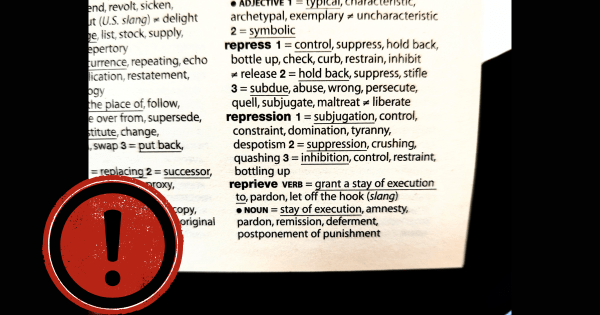
It is safe to say that the term repression has been rather dirtied since the emergence and popularisation of Freud’s psychoanalytical theories. When it comes to the human psyche and how we store memories, I quite like the third of Collins Thesaurus three definitions; to “subdue, abuse, wrong, persecute, quell, subjugate, maltreat” – opposites of ‘liberate’ (p. 237, 2008).

(Yes, I own a physical copy of the Collins Thesaurus because I am a big nerd. Also, I like the way it smells.)

I am writing this not to discuss or critique freudian views, but to have a closer look at what we know about these so-called repressed memories and, to some extent, the treatment of psychological symptoms that may be rooted in traumatic events, from which the brain decided to ‘quell’ the circumstances because it didn’t seem productive to dwell on them at the time of their occurrence.

Firstly, the repression of memories is largely understood as a defense mechanism. In my own words; the unconscious makes the conscious existence more tolerable by hiding something that may be too difficult to grasp, or even live with, when the event occurs. It is not a conscious decision to forget something – that would be ‘suppression’.

I found myself thinking a lot, when studying pedagogy and special education, that whenever my books or professors mentioned resilience in children, repression was part of the package. As in, resilience was synonymous with a natural ability to unconsciously ignore otherwise unbearable trauma by blocking out their occurrence. This may be true – I never managed to investigate outside of my notions – but I find that resilience is more of a fight or flight response in that it enables you to get through something. When the trauma turns into a prolonged event, however, there is no telling when or if you’ll come out of it.

I theorise that the above creates an accumulation of unwanted/repressed memories that in turn start to fester, ultimately manifesting as symptoms of depression, anxiety, paranoia, PTSD – a disease that makes every waking moment drip with existential fear – and no way of finding out where the symptoms stem from when the pressure is released and you finally have a second to sort your head out. Thus, you’ll find yourself in need of professional help. However, if you cannot explain to yourself what caused your view of the world, or your coping mechanisms, it is almost impossible to put into words and efficiently communicate that which is left of these events – mainly the ambiance, smells, the emotions you felt – to someone that can actually aid your becoming a functional adult.

I have struggled with this myself, in different scenarios, and I’ve also been very aware/fearful of the fact that the act of trying to bring forth a repressed memory can create an unreliable or ‘false’ memory due to the suggestive invocations facilitated during EMDR, or awaken something that one is not yet ready to deal with, at least not without accompanying memories to the event that may remain repressed after such a session. Psychology Today has an interesting article about the debate over repressed memories, where you can read more about how trying to force the re-emergence of a memory may not have the desired effect by clicking anywhere on this sentence. It’s an interesting read.

I found another article on the same site, where the headline simply read “There’s No Delete Button in the Human Psyche – Fortunately”, which is something that I found to be true this morning, when I was sent a document that highlighted something that I, from June 2002 and up until that moment, had absolutely no recollection of. What’s more, it dislodged a few other bits from the same time period. This is what possessed me to write about repression, rather than the topic I’d planned on writing about initially (just keep an eye on the blog next week – you’ll discover what that was then).

Our brain’s memory – our hard drive – can be a complex entity. I find that my own, very much like the Cloud or One Drive, oftentimes cannot be bothered telling me where it has stored something. It’s there, but elusive – it only shows up when I’m not paying attention – more often than not in the shape of a flashback that makes my whole day go topsy-turvy, spurred on by a familiar smell or scenario (or when I am trying to attach one of my most recently used files to an email, on my computer’s hard drive).

So, I think there’s certainly a link between repressed memories and childhood trauma. There is a good chance that we need to accept and acknowledge the fact that these memories remain inside of our brains as shadows, rather than perhaps trying to force them to come out, in order to heal our repressed adult selves. And I am sure there is no universal solution to how one should go about it either. But I reckon finding a professional hand to hold for the especially bumpy parts of the winding road that life can be is as good advice as any.

You can read more about repressed memory and false memory by clicking this sentence.

Learn more about Repressed trauma by clicking this one.

I also have a theory about the connection between repression and Alzheimer’s disease, but we will have to save that for another day.

As always, please go check out my book if you enjoyed my writing – you might like it.

I’ll leave you with a link to a YouTube video of one of the finest songs ever to be performed in a musical, by the great Elaine Paige.

See you next Tuesday!

Statistics, diagnostics and the media – why certain news should only be distributed by experts

This is a double-edged sword. On one hand, we have the right to information that concerns us, yet on the other, the information gathered from these reports is often misinterpreted by uninformed journalists and thus miscommunicated through news outlets that fit their headers to accommodate the most clicks, instead of conveying what the researchers have found. (By uninformed, I mean that most desk journalists lacks the specific expertise to be able to understand properly the context and how scientific research is conducted, not that they are unintelligent.)

Uncritical A/B testing practices symbolises the death of integrity in modern media.

In short, psychological research should be published via professional channels and localised to the target audience, to prevent misunderstandings that can lead to the spreading of false information, or worse; greater socioeconomic inequality.

Because the fact remains, that mental health articles published by your bog standard online news outlet often refers to sufferers from mental (and physical) illness as a ‘them’; a third-person object.

I recently read somewhere, that ‘poor people have mental health issues and mental health issues lead to poverty’. That was the gist of it anyway. With that whole ‘third person’ mentality, one could assume that the tabloid readers and the more affluent members of society will take this to mean that the mentally ill are a burden on society. Maybe even the reason why the economy is in the shitter, so to speak. I am inclined to believe that news sites relying solely on A/B testing to increase their readership make matters far worse in those few instances they’ve got some actual news to report.

It’s the same with any articles on certain diagnoses; they are presented as a peculiar subject, something weird or bizarre, rather than something that affects a lot of people, both directly and indirectly. Of course, so-called reality shows such as The Undateables aren’t helping. And, no, I will not link to such horrific social pornography (for lack of a better term).

The solution to changing how mental illness is viewed is simple; psychoeducation. If the general public was to be presented with proper explanations and definitions by mental health experts, they, WE, would understand that everything is not as black and white as the media presents to us in its current uncaring and often ignorant state.

There are plenty of official networks and non-profit mental health organisations that publish research findings and psychology related news through easily digestible articles, but they are drowned out by the noise. Some of these, however, I will link to at the bottom of this post.

So, why should we care about psychoeducation, especially if we are not experiencing illness ourselves? I’m glad you asked. The World Health Organisation published numbers from 2019, indicating that as many as “1 in every 8 people worldwide are living with a mental disorder“. It would be fair to assume that more than one of ‘1 out of 8’ of us have carers, family or friends, or even colleagues, that are indirectly affected by our illness in some way. Not to mention that a lot of disorders can be hereditary. If we understood everything a little bit better, it might be easier to cope with certain things. Mass media are not the right communicators for this particular job.

Psychoeducation is important in a patient’s journey to recovery from or management of any mental illness, regardless of age. One can argue that it is essential – in order to understand yourself and your condition, you must first understand how it affects you. Science Direct has a more in-depth article on psychoeducation available on their site, if you want to learn more about what this entails.

Furthermore, psychoeducation can provide you with tools for when the mental health services close down after office hours or on bank holidays, which, for some, can be the most challenging parts of the year. As a bonus, proper psychoeducation can help everyone around you to understand things a little bit better as well. Wouldn’t it be nice if the nuanced field of psychology could be presented by someone with a passion for it, rather than someone that’s been told to ‘make the headline clickable’?

That’s probably more than enough for today – and I have some psychoeducation of my own to get back to. Thanks for reading!

See you next Tuesday.

Here’s a list of excellent outlets for those of us who want to learn more about ourselves and our loved ones:

Mental Health Mates UK

The ADHD Foundation

OCD UK

Depression UK

Anxiety UK

I would also like to recommend the following two podcasts, one of which tackles how mental health issues affect our daily lives in delightful, laidback, and sometimes emotional, human conversation, and the other an ADHD specific podcast, which offers interviews with leading experts on the field, as well as well-known guests.

The Life of Bryony

ADHD Chatter

Blog at WordPress.com.

Up ↑