If you consider yourself to be a creative person, I am willing to bet you have also found yourself staring so deep into the abyss on enough occasions to either having sat across from a mental health professional at some point in your life, or someone has pointed out to you that maybe that would be a good idea. Regardless, you’ve had a chance to consider whether or not medication is for you. And many of us tend to opt out. We’d rather live with crippling depression, biweekly panic attacks, compulsions and partner-repelling mood swings than potentially lose the one thing that makes our existence make sense; our creativity.
Let me just pause for a second to let you know that I am aware that this is a myth that’s been thoroughly busted. You can read about this and other SSRI related myths by clicking on this sentence.
Still, it’s a very real fear that needs to be acknowledged. If you cannot fathom why, this post is not for you. Go read something else. I can recommend my book. Or, if you have yet to listen to Rob Halford’s autobiography on Audible, you should go do that. It is fantastic.
If you do know what I’m talking about, though, you’d be very interested in what I heard in a podcast I listened to recently… What we (us mental patients of the neuro-spicy kind) mean by creativity in this scenario is not necessarily how it’s perceived by the people prescribing the meds. On the contrary, when we state our fear of losing our creativity as the main reason were so sceptical, they seem to think our meaning is that we’re afraid we’ll lose the ability to think outside the box. I.e. they think that, by creativity, we mean creative thinking, in regards to problem solving.
Whereas most of us mean the ability to create something unique, freely and without template, fuelled only by an inner compulsion to create. Essentially, its our life force; what makes us us.
Perhaps we should’ve used the word imagination instead. But, it’s not on us. As defined in most thesauruses and dictionaries, creativity is “artistic or intellectual inventiveness”. Yet, in a post found on Psychology Today, we see another example of the writer seemingly focussing on the problem solving aspect rather than the imaginative.
I would be remiss if I’d concluded that all mental health professionals are of the same opinion as this single writer and the neurologist from the podcast, but I do think that it’s worth noting that the person being prescribed the medication might not be equally as immersed in the DSM diagnostics sociolect as the person holding the prescription pad.
It is a myth, though. SSRIs or ADHD meds won’t kill your creative ability (although some SSRIs may cause brainfog, but most ADHDers experience that regardless).
Some lyricists may fear that they can only truly write when they’re depressed, because that’s when they’re the most connected to their emotions or whatever. That’s a load of bollocks. You can certainly learn from depressive episodes, but being depressed isn’t going to make you the next Bob Dylan – if that were the case, you could get the same effect from downing a bottle of red. If you’re really talented, though, you don’t need any of that shit – the talent is part of your personality. And, as far as I know, they have yet to make any FDA approved personality altering drug.
There are logical solutions to creative blocks as well – we’re just too impatient to admit it.
That’s it for today. I reckon my next pist might be real morbid. (Or I might go down a panic attack related wormhole, full gonzo).
Either way, see you next Tuesday!
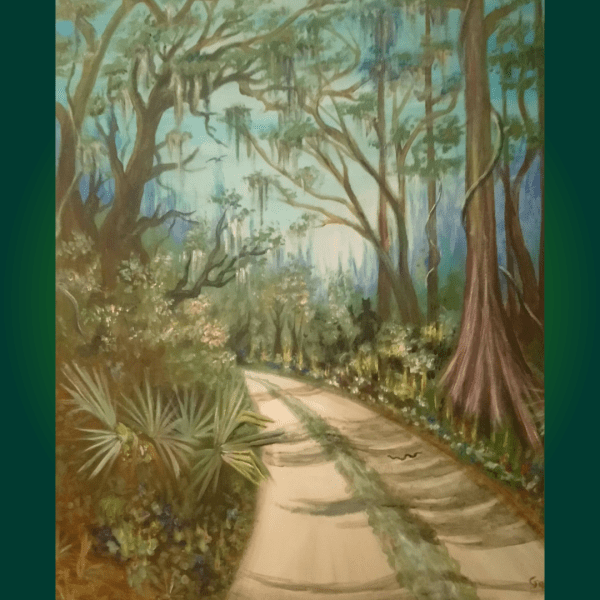
Also, the featured photo is of one of my favourite paintings, ever, found in the Voodoo Museum in New Orleans (quite possibly a Voodoo Charlie original). If you’re ever down NOLA way, you should check it out.
 Gonzo With the Wind