What if your perception of pain is all wrong?

There’s no bandage for a bleeding heart. No dressing for our emotional wounds. No over-the-counter remedies to dull the ache of losing a friend. Yet, this psychological, often dubbed emotional, pain can make us hurt like hell, in a very real and physical way.

(Personally, I don’t like calling it emotional pain – I feel like it takes away some of the validity of the experience, but maybe that’s just me. I really must stop being so emotional).

What’s more, psychological pain has no set expiration date. Physical pain, however, is often referred to as acute or chronic, meaning it comes with an indicator as to how long you will have to suffer and/or how often. (Although, I’d argue that psychological pain can also be both acute and chronic). Physical pain can be classified as either somatic or visceral, i.e. something that happens to the body visibly or internally but not the mind, and the person dealing with the pain will be able to explain or point to the location and extent of the pain with some degree of accuracy (providing they are conscious).

With a broken leg, you know the pain will stop at some point. If one of your toenails fall out after a long run, you know a new one will grow back in its place. Plus, there’s heaps of painkillers, bandages and other tools and remedies to help us keep the discomfort to a minimum while we heal. When the pain is coming from a place within that’s neither tissue nor bone, on the other hand, we’re meant to just suck it up and get over it. You can read more about the physiology of pain by clicking on this sentence.

My trusty Collins Thesaurus A-Z defines pain as “1 suffering, discomfort, hurt, irritation, tenderness, soreness 2 ache, stinging, aching, cramp, throb, throbbing, pang, twinge 3 sorrow, suffering, torture, distress, despair, misery, agony, sadness” (p. 200, 2008). I think we can agree that these terms can all be associated with psychological pain, some more than they can with physical pain – although, physical pain might lead to the third definition. In any case, pain is processed and interpreted by the brain, which then executes a response to protect us from whatever caused it. As far as I can tell. So one could assume that the pain suffered from a break-up could make someone hesitant to enter into a new relationship. But what is it that makes us hurt; the sensation itself, or the self-fulfilling prophecy of our expecting something to result in pain? Have we been conditioned to expect physical pain, when what we’re really feeling is a type of fear?

Imagine, if you will, that you are quite new to this world and gravity is still a mystery. The ground you know to be completely solid, your foundation, your only constant, is pulled out from under you and you are being pulled through the air by an invisible force with no feasible end in sight – wouldn’t you be fucking livid? Perhaps so terrified you soil yourself the first time this happens? Regardless of the accidental spillage of excrement, I am certain the experience might bring you to tears. And when you finally hit the ground safely, albeit with a bang, you don’t really care that you may have scratched your knee, but you’re so afraid this might happen again, that you can’t stop crying. And then, some unwitting adult in an attempt to make you feel better tells you “that didn’t hurt, get up”, as if the fear you are experiencing is invalidated as an incorrect response and that what you should be feeling is physical pain. Perhaps then, in your shell-shocked state, you feel as if you should be ashamed of your fear, that being afraid is silly.

We all know the adult in this scenario is only trying to make them stop crying by semi-gaslighting them into thinking that they are wrong to let the situation scare them and that everything is just fine and dandy, thinking the pain from the fall is what made them so inconsolable, but I’ve come to think that this is more than a little misguided. That, perhaps, our own conditioning has made us forget the real reason we feel like crying when we are faced with unfathomable or unexpected scenarios. If so, this could be detrimental to our development in a multitude of ways. You’d be inclined to suspect that it has shaped how our society views mental health issues, as well as the medical treatment of psychological symptoms and diseases.

Perhaps our first fall is when we start associating anxiety, fear and anguish with shame and begin to think that it is easier, or even more valid, to deal with physical pain, rather than ailments of our psyche? No wonder people self-medicate with booze, pills, sex or physical trauma in the shape of extreme sports or body art to escape the sort of pain that leads them to shame.

For someone who struggles with psychological pain, physical pain can be perceived as controllable. Being able to endure it can give you a false sense of control. No one can control the scenario your mind creates when you hear things go bump in the night when you’re trying to sleep. But it sure can make you feel like the smallest thing, no matter how big and strong you are.

That’s it for now. Just some food for thought.

See you next Tuesday for a fresh batch of verbal incontinence. I’ll try to use the word control a little less. Meanwhile, you can listen to the live version of the newest The Darkness album, Dreams on Toast, on their Bandcamp by clicking on the album title.

Perhaps you’ll listen to it whilst reading my book, which you can purchase by using the links on my Buy the Book page.
Understanding repression

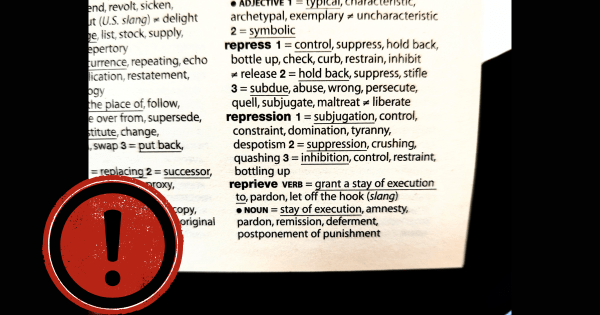
It is safe to say that the term repression has been rather dirtied since the emergence and popularisation of Freud’s psychoanalytical theories. When it comes to the human psyche and how we store memories, I quite like the third of Collins Thesaurus three definitions; to “subdue, abuse, wrong, persecute, quell, subjugate, maltreat” – opposites of ‘liberate’ (p. 237, 2008).

(Yes, I own a physical copy of the Collins Thesaurus because I am a big nerd. Also, I like the way it smells.)

I am writing this not to discuss or critique freudian views, but to have a closer look at what we know about these so-called repressed memories and, to some extent, the treatment of psychological symptoms that may be rooted in traumatic events, from which the brain decided to ‘quell’ the circumstances because it didn’t seem productive to dwell on them at the time of their occurrence.

Firstly, the repression of memories is largely understood as a defense mechanism. In my own words; the unconscious makes the conscious existence more tolerable by hiding something that may be too difficult to grasp, or even live with, when the event occurs. It is not a conscious decision to forget something – that would be ‘suppression’.

I found myself thinking a lot, when studying pedagogy and special education, that whenever my books or professors mentioned resilience in children, repression was part of the package. As in, resilience was synonymous with a natural ability to unconsciously ignore otherwise unbearable trauma by blocking out their occurrence. This may be true – I never managed to investigate outside of my notions – but I find that resilience is more of a fight or flight response in that it enables you to get through something. When the trauma turns into a prolonged event, however, there is no telling when or if you’ll come out of it.

I theorise that the above creates an accumulation of unwanted/repressed memories that in turn start to fester, ultimately manifesting as symptoms of depression, anxiety, paranoia, PTSD – a disease that makes every waking moment drip with existential fear – and no way of finding out where the symptoms stem from when the pressure is released and you finally have a second to sort your head out. Thus, you’ll find yourself in need of professional help. However, if you cannot explain to yourself what caused your view of the world, or your coping mechanisms, it is almost impossible to put into words and efficiently communicate that which is left of these events – mainly the ambiance, smells, the emotions you felt – to someone that can actually aid your becoming a functional adult.

I have struggled with this myself, in different scenarios, and I’ve also been very aware/fearful of the fact that the act of trying to bring forth a repressed memory can create an unreliable or ‘false’ memory due to the suggestive invocations facilitated during EMDR, or awaken something that one is not yet ready to deal with, at least not without accompanying memories to the event that may remain repressed after such a session. Psychology Today has an interesting article about the debate over repressed memories, where you can read more about how trying to force the re-emergence of a memory may not have the desired effect by clicking anywhere on this sentence. It’s an interesting read.

I found another article on the same site, where the headline simply read “There’s No Delete Button in the Human Psyche – Fortunately”, which is something that I found to be true this morning, when I was sent a document that highlighted something that I, from June 2002 and up until that moment, had absolutely no recollection of. What’s more, it dislodged a few other bits from the same time period. This is what possessed me to write about repression, rather than the topic I’d planned on writing about initially (just keep an eye on the blog next week – you’ll discover what that was then).

Our brain’s memory – our hard drive – can be a complex entity. I find that my own, very much like the Cloud or One Drive, oftentimes cannot be bothered telling me where it has stored something. It’s there, but elusive – it only shows up when I’m not paying attention – more often than not in the shape of a flashback that makes my whole day go topsy-turvy, spurred on by a familiar smell or scenario (or when I am trying to attach one of my most recently used files to an email, on my computer’s hard drive).

So, I think there’s certainly a link between repressed memories and childhood trauma. There is a good chance that we need to accept and acknowledge the fact that these memories remain inside of our brains as shadows, rather than perhaps trying to force them to come out, in order to heal our repressed adult selves. And I am sure there is no universal solution to how one should go about it either. But I reckon finding a professional hand to hold for the especially bumpy parts of the winding road that life can be is as good advice as any.

You can read more about repressed memory and false memory by clicking this sentence.

Learn more about Repressed trauma by clicking this one.

I also have a theory about the connection between repression and Alzheimer’s disease, but we will have to save that for another day.

As always, please go check out my book if you enjoyed my writing – you might like it.

I’ll leave you with a link to a YouTube video of one of the finest songs ever to be performed in a musical, by the great Elaine Paige.

See you next Tuesday!

Blog at WordPress.com.

Up ↑