
Lessons loss taught me

This past Sunday marked the 30th anniversary of the death of someone very dear to me. Thirty years gone, and my grief is so tremendous, still, that it manages to throw me off balance and send me straight into the void of darkness. Surely, that’s not healthy? It never used to bother me before – back when my entire existence consisted of me wallowing in my putrid pigsty of pain – but as that’s no longer an option, I’ve been tempted into a little research project to find out if my current suspicion can be backed by science.

My theory is this; being unable to grieve properly at the time has affected how I deal with feelings in general and thus stunted my emotional growth. I am sure that a lot can be learned from the experience of losing a loved one and dealing with the loss. As cheesy as it may sound, I am curious to find out if allowing myself to feel will help me heal. I think it just might be instrumental.

There are a million articles online about how important the grieving process is, but I think the way writer Jon Scalabrini articulates the detrimental effects of suppressing or not acknowledging certain feelings in his article on Peacefully.com illustrates my understanding perfectly and succinctly:

“By avoiding emotions, one creates future challenges; thus, “moving on” in the short term ultimately creates long-term difficulties.”

You can read the article in full by clicking anywhere on this sentence.

In my case, I was forced to move on too quickly due to matters outside of my control. This taught me – and my subconscious – that my feelings were not valid or important and therefore should not be acknowledged. My black and white thinking made sure this would be applied to all future scenarios where I’d be likely to feel strongly about something – or someone – in any way. I was unable to see how this could be circumstantial. So, to make things easier for myself and everyone else, I adapted. Or, likely overcorrected. I adopted a few terrible coping mechanisms once I entered young adulthood, which have continued to block my path to enlightenment.

I feel as if this is something that I need to un-learn, so I was delighted to find an episode from the American Psychological Association’s podcast series Speaking of Psychology, where interviewee Dr. Mary-Frances O’Connor, an associate professor of psychology at the University of Arizona, spoke about her studies on grief and grieving and how grieving can be a form of learning, among other things. The episode is called How grieving changes the brain and is available on the APA’s website, as well as on podcast streaming platforms.

I was not so delighted, however, to find that I likely suffer from prolonged grief disorder. Oh well, I’m sure there is CBT for that. Anyway.

O’Connor goes on to explain how the grieving process involves having to learn to live our lives without the person we’ve lost in it, that we need to find out who we are, now that the world around us has changed in such a profound way. It’s a rewiring of the brain – a learning process. Neuroplasticity. It’s a very interesting episode, as they go into the difference between grief and grieving, links to depression and different types of therapy that can help with the grieving process.

My main take from the episode, to benefit the validity of my theory, is that we must acknowledge the feelings we are experiencing for us to go through the process and come out on the other side of it stronger than we were when we went in. It is my understanding that avoidance is the opposite of helpful if we want to learn and ultimately move on. And accepting a loss as reality does not mean that we have to stop loving the person they were when they were still here, but that we cannot let that loss or its circumstances dictate how we live our lives from that point on. We need to accept the fact that it is okay to love again, whilst realising how a new love does not take away from the old one. Moving on does not mean that we have to forget, but perhaps – with time – we can learn how to look back at the fond memories that made us cherish them so, instead of clinging to the sadness and the trauma we experienced when they were taken from us.

Now, back to those “long-term difficulties” from the Scalabrini quote. My experience taught me that I was worthless. A deep emotional wound that has kept growing and festered over the years, by giving me the gift of trust issues, self-deprecating behaviour and self-sabotage, and only allowing myself to “feel” or emote when I’ve had enough alcohol to justify letting the tears stream freely down my face. I’d schedule my emotive cries, so not to become emotional in public. But by doing this with my painful emotions, my brain would of course apply this to any positive feelings as well, meaning that I wouldn’t allow myself to acknowledge any feelings of happiness either.

It’s a lot easier to convince yourself that you’re unlovable, than it is to remain hopeful that someone will one day actually think you’re something other than a huge piece of shite. Unless you start administering some much needed self-care post-haste.

I think, based on what I’ve learned today, that my theory holds up. What’s more – because of this – I now realise that it is not too late to start rewiring my brain so that I can make my way through the final stage of the process of my prolonged grief. Acknowledging the feelings, accepting the loss and starting to look at how my life would be different if I wasn’t so gung ho on treating everything based on something I interpreted incorrectly three decades ago are all parts of the healing process.

Never let anyone tell you how you should or should not feel – it can only lead to bad things, as we’ve learned from my previous post on the importance of having your emotions validated.

That’s it for today. Buy my book! See you next Tuesday.
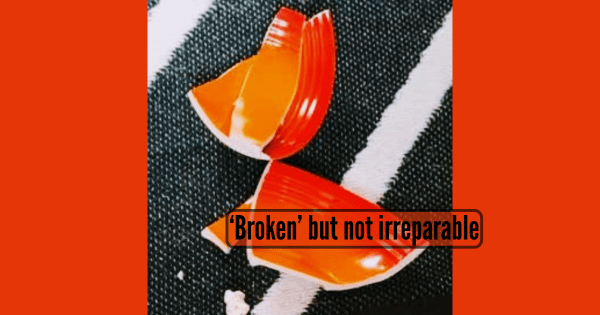
Broken seems to be the hardest word

Or, at least the word appears to be difficult to hear for most of the ADHD podcasters. I’m not sure exactly when it became obligatory to end every episode with a ‘Remember, you’re not broken – just different‘, or something in the vein of that. To that, I have precisely one thing to say: Fuck off.

This type of message can be construed as the speaker is telling someone how to feel. There’s a word for this; invalidation.

American psychologist Dr Jamie Long defines invalidation as:

“The process of denying, rejecting or dismissing someone’s feelings. Invalidation sends the message that a person’s subjective emotional experience is inaccurate, insignificant, and/or unacceptable.”

Long goes on to explain that telling someone they shouldn’t feel a certain way ‘conveys contempt and superiority’. Regardless of how unintentional it may be, invalidation can be ‘one of the most damaging forms of emotional abuse’, according to Dr Long (2017).

You can read the article in full on her website, by clicking this link.

With some facts to justify my opinion and highlight the importance of acknowledging others, I’ll get on with my rant.

To my knowledge, no prophet worth their salt ever claimed to be one. Apart from Brian, perhaps, but we all remember that he was just a ‘very naughty boy‘. Yet, a horde of mental patients turned self-proclaimed neurodivergence experts have come to think of themselves as the second coming, or perhaps a little closer to the big man; omniscient.

They seemingly liken themselves to the Messiah of the looney bin – leaders of the un-broken newly diagnosed. Behaving as if they have all the answers makes them a potential danger to themselves and others, just because they’ve been diagnosed with something that made them crawl into a seemingly bottomless search engine wormhole, or even crack a book in some cases. Ironically, in true ADHD hyperfocus fashion, they seemingly forgot to check the facts or look for more sides to the story when they’d had their fill of research and decided their newfound knowledge must be broadcast to fellow sufferers, because now they have found the answer! Come off it.

As Attitude puts it in their well-researched article on hyperfocus, once in this state, we can often become ‘so engrossed we block out the world around us’. Which, of course, can be good for our personal learning.

However, it can make some people forget that the information we devour might not be applicable to others. I particularly find this to be the case with podcasters with AuDHD, which shouldn’t come as a massive surprise, seeing as some of them struggle to see past their own nose on a good day. Put in a more delicate way, in an article by the NHS on autism in adults, people with autism ‘find it hard to understand what others are thinking or feeling’ and can ‘take things very literally’. These traits, combined with hyper fixation and a WiFi connection, is perhaps a concoction best left to sit safely behind an unhackable paywall. Which, in fairness, someone with AuDHD would likely be able to set up, given they have a special interest in computer programming.

Anyway, we are back to the initial phrase. The ‘you are not broken‘ness of it all. Due to AuDHD podcasters innate quality of having trouble putting themselves in somebody else’s shoes, they may fail to see how this statement might make someone slightly more emotionally inclined feel as if their feelings have been dismissed and trivialised. Because some of us actually need to feel a little broken, in order to put ourselves back together again.

Either way, someone with an extreme need for attention might not be the best educator. And if you’re the host of a podcast where you are the main attraction and self-proclaimed expert, you should’ve guessed it, you are bordering on narcissism. It’s like going down to Speakers’ corner and shouting your opinion for everyone to hear, but the problem is that, since you’ve invested in a mic and some audio editing software, people are likely to think that you’ve actually got something of value to share, outside of your own lived experience.

I’m not saying all people with autism are narcissists, nor do I mean to claim that all of them are utterly devoid of empathy, I am simply pointing out the damage something unintentional can cause if you don’t stop to take all of the facts adhering to a diagnosis – and not least differences in personality and/or lived experience – into consideration before you present something as a universal truth.

Invalidation (and autism) aside, there’s something to be said for letting yourself really feel what you feel, in order to achieve a sense of control over the emotion – rather than having it control you.

Don’t get me wrong – I don’t think wallowing is particularly good for you either. But surely you are sending some conflicting signals to your unconscious if you let someone else dictate how you feel. I suppose it can be nice to hear that someone else thinks that you should think that you are a good human specimen just as you are, but it doesn’t take away from the fact that you yourself feel as if you are in dire need of repair.

Most of us can’t just adopt a mantra of saying ‘I’m not broken’ to ourselves in the mirror until we’re blue in the face and hope that some sort of unbrokenness will manifest all of its own – we have to acknowledge and respect the process before we can trust it.

So what if I am a little broken right now. But it is crucial to my recovery that I can be allowed to acknowledge that and start learning how to rebuild myself over time – adopting new, healthier coping strategies that will keep me from falling a part too quickly the next time life throws me a few curveballs. Your telling me I’m not broken really isn’t helping when that’s how I feel. And I am sure others feel the same way.

My process is my own and I need to work through it, without someone else trivialising my emotions or my situation. I need to be able to imagine for myself a life in which I am a little more together in order to find the steps to get there.

I forget who said this, but I think ‘there is beauty in something that has been broken and put back together, because its new composition makes it stronger and more unique‘ is a good quote. Might have gotten it from a Hallmark movie, actually. Anyway.

We can all feel a little broken sometimes. That should be okay, shouldn’t it? It shows that we’ve got some perspective and self-awareness.

The fact that you feel a little fragmented right now, doesn’t mean you won’t at some point become something that feels a bit more whole – or that you should come to believe it’s a permanent state. Quite the opposite – we just need to find all the pieces and the right adhesive before we start piecing it all together.

There is great strength in admitting weakness. And you can quote me on that.

See you next Tuesday, for a special Piemageddon update!

Here are some sick Bad Religion tunes as a reward for reading. A proverbial potpourri of punk at its very finest. Enjoy!

Blog at WordPress.com.

Up ↑