A gift for those dreading the holidays

It’s Sunday, so I’ll keep it brief – this is just a bit of blatant self promotion anyway. And, boy, do we get enough of adverts thrown at us around this time of year, eh? Anyway, this post will be dedicated to the story of Hannah; Journey to the Centre of the Mind – a Particularly Mental Gap Year, and why you should bring it into your life if you haven’t already done so.

The two pieces of feedback I’ve received most often from my readers is that A: The book is almost impossible to put down, and therefore a quick read, even for the slower readers out there, and B (possibly most importantly): Hannah’s story lets them know that it’s not just them having a shit time of it – other people struggle with some level of the same shit too – that black dog can be an impossible beast to tame if you’re doing it alone.

This book is for the ones that know that there are layers to every feeling, that any tiny speck of happiness rarely comes without a tiny sliver of guilt, the outsiders, the ones buckling under the pressure of society’s expectations (or their own expectations), it’s for those who don’t have anyone they trust enough to share their stories with, those who feel so out of place that it feels as if the universe is working against them. And for those that are trying too hard to be a good friend to someone who struggles, and end up pushing them away in their misinformed attempt at helping.

In my humble attempt at persuading you to buy a copy of my book, I will share with you what made me write this in the first place.

I occasionally go searching for that terrible review that’ll crush my dream of any writing career. Squinting so heard that I can barely see – in sheer terror of what I might find – I type the title of my book into the search engine. The last time I did this, though, I was pleasantly surprised – to say the least. One might even suggest that I did the same search on a few different devices and in incognito mode before accepting the reality of the fact; three 5-star ratings on Goodreads, and two reviews that brought tears of joy (and relief) to my eyes. One of them posted by the magnificent Jess of The Next Chapter fame. You can read the reviews on Goodreads by clicking anywhere on this sentence.

My book is print on demand only (because I like trees), so if you feel like giving someone a different book for Christmas this year, you need to order it by the 5th to get it from the printer’s on time – it’s available in most countries and I’ve collected a few links for you if you click on this sentence.

The Ebook, however, is of course instantly available if you find yourself searching for something special on the day itself. I’ll include the link again here, as a lot of the outlets above offer up the electronic version as well.

Should the reviews inspire you to grab a different Christmas – or Hanukkah – gift this year, for yourself or someone you thing might need it, you have until the 5th of December to get it back from the printing press at Books on Demand in time, using the links above.

If you prefer reading your literature on an E-reader, the electronic version is cheap as chips on most platforms.

In the famous words of Skeletor: Until we meet again!

(Yes, Tuesday, as per)

Single and forced to mingle

Recently, big business found yet another way for consumerism to separate us from our wages, under the guise of discounts and special offers in celebration of a new (to me, at least) money making scheme/unofficial global shopping holiday; singles’ day. As far as I can tell, the tradition goes back a decade or two, as a celebration for people that are not in relationships to come together for a fun time, but I refuse to put the phrase into my search engine to find out how old this new organised shopping frenzy is. Regardless, I suspect this capitalist take on the event has been created to make room for the useless shite shops, hotels and airlines need to stock their digital shelves with for Black Friday.

I would have applauded the celebration, had it actually celebrated singlehood and single folks. It would have been great, had the offers and discounts been exclusive to those of us ‘fortunate’ enough to pay our bills by our sorry selves – living alone is bloody expensive – yet that’s of course not how it works. Not only can married/coupled folks benefit from the same singles’ day ‘offers’ as those of us sans soulmates – I even received an offer from a travel agent (that will remain unnamed) via email, where they offered me an “even better discount” if I was “travelling with a partner”. Another email explicitly said “don’t worry if you’re not single, these discounts applies to you as well, as long as you use the code XX”. What the fuck?

So, as a single person, I am expected to pay more for my flights and accommodation when I travel somewhere by myself all year around, but couples can save more on a deal – a deal that exists because of single people – than the actual single solo traveller? Why should they get my discount on the one day out of the year where businesses could have done something nice for us and let us save a few bucks on something that’s not in bulk, for once? But no. Once again, the singleton is reminded of their place in society and capitalism is the ultimate victor. Enough, already.

I get it. The economy is fucked. But that doesn’t justify screwing us over. Just because we’re used to not getting any, doesn’t mean that we’ll happily lie down and take it when offered the chance.

And with this, I find myself at what inspired my little rant today; the difference between consent and compliance. By no means do I claim to be the first person to point out the fact that there is a difference – I will gladly admit that my inspiration comes from not one but two podcasts I’ve been listening to lately (Speaking of Psychology and MissUnderstood/Sorry, I Missed This), I just found that their take on it made me see some of my past mistakes in a new light. Additionally, being able to differentiate between the two will never not be important.

If you’re missing the logical connecting step from shopping to consent here, I will list a few of the reasons why I am single (and have been for most of my life).

  1. Non-singles and ‘normal’ singles alike tend to assume that all single folks are tirelessly and desperately looking for ‘their person’. Whilst many are doing precisely that, there are also those of us who have found the one we would like to be with, but like with many of the universe’s cruel jokes, our beloved does not be-love or even be-like us back, or they are simply in a relationship already. So me being the way I am (i.e. possibly a smidge hyperfocused on anything and everything that manages to tickle my fancy) will more often than not be inclined to wait patiently for their relationship to peter out before making a move and/or moving on. There’s a need to know if they would feel the same if they could. In short, it’s not my lacking the ability to find someone, or having impossibly high standards. Nay, for me to give up my life for a relationship, I need it to be with a person that I actually like enough for me to feel as if I’m not giving anything up at all.
  2. It’s about the person, not the relationship. It seems a lot of people are desperate to be in a relationship. So desperate, in fact, that they suffer through physical violence and psychological warfare, prostitution, childbirth, vasectomies, you name it. They just want to show the world that someone chose them. But, did they, though? Noooooo thank you. Also, I quite like the peace and quiet. Next!
  3. Then there’s the rejection sensitivity that comes with my ADHD, and the RSD, the misguided attempts at second guessing every move, over analysing every word, every movement, my forty years of being told that other people’s needs are far more important than my own, which incidentally has caused me to gaslight myself into thinking that compliance is consent.

As you can tell, it is probably best that I stay away from the relationship game. I have been in too many situations where I’ve felt as if I had to choose between having to deal with a negative reaction if I’d said ‘no’ or accepting the awful feeling of guilt that would come from not meeting their needs and having them hate me on top of it. There was no way I could win. Just the thought of hurting them hurt me more than the pain that they – and, to some extent, I – put me through. I’ve been too afraid to go to the police when I should have done, on more than one occasion, just because I couldn’t handle the thought of the implications it would have for my attackers. Why I didn’t think as far as what damage they would be able to do to others when they were able to walk free is beyond me – I guess I just assumed that I was the only sort of person that would deserve being treated that way. No one in their right mind would do such horrible things to someone pretty, someone nice, someone that’s worth something. But I’ve realised now, that it’s not only us uggos that get raped. Unfortunately, it seems a lot easier for people to believe the pretty ones.

Now, I’m not saying romance is dead. Quite the opposite! And I have a lot of lovely couple friends that have great relationships. I think they deserve all the love in the world. I’m just saying that on singles’ day, they can back off and leave the special offers to those of us that don’t have anyone to split the rent with. I promise not to take any of their valentine’s day thunder. And, who knows – perhaps there’s love on the cards for me as well?

Yes, I am looking at you, Michael Palin.

It’s late! We should all go to bed. But before you do, remember to buy a copy of my book – if you want it by crimbo, you’ll need to order it by the 5th of December.

Next week, I’ll write a little something about limerence. See you next Tuesday!

Bridging the gap

The structure you see looming over what may or may not look like a portal to an alternate universe took just over three years to complete. The bridge it replaces had served as a link between the two sides of the city centre since the 1930s. With the bridge gone, it was as if a great divide appeared in the wake of the demolition – at least from a commuter’s point of view. Sure, there were pedestrian crossings nearby, but no direct bus link or road access, unless you fancied the deluxe version of the scenic route. The new bridge sure is a sight to behold, though. Also, very functional and bridge-like.

I’m not entirely sure where I was going with this – I just like the photo.

And I am blocked.tae.feck. Not just writer’s block, but blocked in every sense of the word. You may wonder how that came about. Or, perhaps you’re wondering why I am so dead set on trying to squeeze out a few paragraphs anyway. Well, here’s why; it’s not just my liking the photo that has compelled me to pound the keys so ate in the evening – the thing is that I constantly find myself expecting everyone to expect me to bridge the gap for them, the way I always used to. I am overwhelmed, with being underwhelmed. And, being overwhelmed really trips me up, so I am inclined to think that I’m not the only one. Yes, I said I was going to write about menopause, but then I just thought to myself; why the hell would I do that, when there’s more interesting things to write about the sex life of the albatross (spoiler alert, they are NOT monogamous, at least if we’re to believe the Ocean Conservancy), or, indeed, some random bridge I decided to shoot from a weird angle.

Looking up at this massive structure, expected to be strong enough to hold the weight of the world, and at the same time be diplomatic and pleasant enough to bring opposites together, I guess something struck a nerve.

I cannot begin to describe just how bizarre it feels when you start recognising cyclical aspects to your own personality. My psychoeducation and treatment has lent me the ability to somewhat objectively observe my own behaviour in a way where I can now almost foresee my actions and reactions before they manifest, but with no means to stop them from happening. Yet, anyway.

There are hundreds of articles on ADHD overwhelm online. On Beyond BookSmart, we learn that “ADHD overwhelm can essentially lead to you feeling frustrated and upset with yourself, causing you to shut down completely, both mentally and emotionally”. Check. The Attention Deficit Disorder Association wrote about how overwhelm can lead to ADHD paralysis and ways to get past it. Others refer to ADHD overwhelm as ‘flooding’. Basically, those of us with emotional dysregulation and/or RSD can get so overwhelmed by our own emotions and environments that we shut down completely. Check, check, check.

I can get so overwhelmed by the one thing on my list that I’ve not managed to check that it feels like the items I did check don’t really matter. Because I do get shit done. Quite a lot of shit, actually, but that one little thing – even if it’s something as silly as booking in for an eye test – makes it impossible for me to move forward with the speed I expect from myself if I keep putting it off. It makes me feel like a failure. It doesn’t matter if I managed to solve 13 Rubik’s cubes in 3 minutes, or if I’ve submitted research that helped cure bowel cancer that same day, everything becomes irrelevant due to my inability to do get the easy, less important, tasks out of the way first.

It is almost 23.15pm and I’ve one more thing to check off my list before I go to bed, so I am going to take the fourth advice on the ADD’s list to heart and “focus on completion, not perfection”. I have a billion thoughts and ideas still fighting over the limited space in my shell-shocked noggin, so I will no doubt be back with something hopefully a little more profound next week. Just need to bridge a few gaps first. Make sense of some stuff. Until then, there’s a new Catharsis album out that I quite enjoyed. Link below.

See you next Tuesday! Oh, and there’s more substantial ramblings in my book, of course. Check it out by clicking on this here sentence.

Hair today – gone tomorrow

– What..? Why are you shouting at me? What’s going on? Hannah squirmed in the ancient armchair, trying to decipher her mum’s facial expression. For some reason, she just kept shouting at her:

Can’t you see the mess you’re making?! The floor is filthy with your greasy strands… it was clean an hour ago! her mum barked, red in the face now. Of course the floor had been squeaky clean, Hannah had only just finished the weekly deep-clean and had finally been able to sit down for a second and not worry about cleaning everything twice (God forbid she’d clean something in odd numbers, so she’d probably cleaned everything at least four times, if not six). Still, she looked around to see if she’d missed something, and when her gaze fell on the floor under her left hand, she had a start – the knock-off hardwood floor was covered in hair. Hannah went to touch the side of her head, as if to check she hadn’t completely lost the plot. Shit! Another bald spot. And all she’d done was sit down and zone out for just a second.

Hannah had been 16 when that happened – the big, ugly thing that had them ship her off to the child psychiatrist’s, who only managed to make things far worse than they had been in the first place, but that’s a story for another day.

The pile of hair on Hannah’s floor was a result of a type of incessant hair-pulling, a condition that had started to affect her everyday life in a major may, typically categorised as a body-focused repetitive disorder (BFRD) called trichotillomania. Many might think that the disorder only applies to the pulling and removal of one’s head hair, as that would be quite noticeable, but it applies to all hair on the human body, from eyelashes to leg and pubic hair.

You can learn more about trichotillomania, other body-focused repetitive disorders and the specifics by listening to the episode Speaking of PSYCHOLOGY did on BFRD by clicking anywhere on this sentence. I will leave a link to the podcast episode at the bottom as well.

Why am I writing about this, you ask? Well, because it is still something that has a lot of stigma and therefore isn’t really talked about or even diagnosed, unless the patient mentions it themselves. Even then, some professionals may not have heard about the condition. Also, if you search for it on line, almost every single one of the top 10 hits will be misleading.

Additionally, there’s a lot of misconceptions around it, as it (and other body-picking disorders) is often overlooked and/or attributed to something else, like an aspect of obsessive compulsive disorder (it is a common comorbidity), low self-esteem, et cetera.

This means there has not been extensive research on the matter. Funding has been pulled from a trichotillomania therapy programme and reallocated towards the OCD clinic at the University Hospital in Norway. But this is a very real disease. It can ruin a person’s life. And it’s not vanity or even picking at something that needs to be removed, it’s an urge that won’t go away. It’s not new either, we can actually track it as far back as ancient Greece. Yet, we still haven’t determined whether it’s \just another anxiety disorder’, or if it’s a different beast entirely.

Luckily, there are people brave enough to take matters into their own hands and shed some light on this. Things are finally about to change, thanks to Oxford professor Clare Mackay and her upcoming book (expected on 2nd April 2026): Keep Your Hair On: Understanding Urges to Pick, Pull or Bite.

Another brave person that’s helped put trichotillomania in the spotlight in recent years – and, in my opinion, helped starting to normalise it – is the fantastic force that is Amy Schumer. In the Hulu series Life & Beth (with a link to the show’s Instagram below), she portrays a young woman that suffers from the disorder. Schumer’s performance is such that you can’t help but get under Beth’s skin. She’s so relatable, and at the same time unique. She’s impossible, yet entirely lovable. Beautiful, yet hardened to fuck by life’s lemons. Wild, yet longing for stability. Much like you or me. (Unless you are an AI robot – one that’s not Gigolo Joe – Because, if you are, you can fuck right off). If you haven’t yet, you should watch it for the casting alone. It’s wonderfully raw, but at the same time uplifting, in a weird way. And the show demands attention towards something that I am very passionate about; seeing mental health issues as something other than someone else‘s issues.

Personally, I cannot wait for another season (please, please, Amy!). Meanwhile, I will continue reading my Stephen King book, also in anticipation of Professor Mackay’s 2026 outing.

See you next Tuesday!

Procrastinato ergo sum

I know… pretty pretentious header, right? Also, I’m pretty sure there’s no such thing as ‘procratinato’ in Latin (or any other language, for that matter) and I refuse to Google it. Perhaps a good name for a super villain. Surely better than Dung beetle Man or whatever DeeC or Morvil is franchising these days. Anyway – if you thought I’d forgotten all about what day it was, you’d be mistaken. I have just been completely unable to complete the first (and easiest) task on my to-do list for a good ten days. Now, for some reason I am only able to cross things off my list in the assigned order, yet I have managed to do a shit-tonne of things not on my list instead. Sound familiar?

Procrastination. Expertly defined by the Government of Western Australia Department of Health as “making a decision for no valid reason to delay or not complete a task or goal you’ve committed too, and instead doing something of lesser importance, despite there being negative consequences to not following through on the original task or goal” (CCI, 2025).

Defined everywhere else as “self-defeating behaviour”. Both correct, both very in my nature. In everyone’s nature, if we are to believe the Internet. Is there a miracle cure, or does it serve a purpose? I mean, the shelves in my fridge have never been cleaner, but they weren’t really that dirty in the first place. Certainly not to the extent that I can justify potentially losing my job over choosing to scrub them for hours on end. Why do we do it?

Some say it’s a perfectionism thing, but I’m not willing to buy that. I’d say it’s the fear of success, a symptom of unhappiness with the situation that requires you to do said task, the task’s implied simplicity fucking with our heads and making us look for pitfalls that aren’t there, or a combination of the three. Or maybe you crave the rush of completing the task at the last minute to obtain a tiny dopamine hit. Prolonged procrastination can be indicative of adult ADHD, but this has to do with poor executive functioning and task initiation. You can read more about the link between adult ADHD and procrastination in an article posted by Berkeley Psychiatrists by clicking on this sentence.

Regardless, procrastination isn’t something that just affects people with neurodevelopmental disorders – it can affect the best of us. And, boy, is it a blooming time suck!

Anyway, that really has to be it for now – I’ve got about a fortnight’s worth of work to do in 72 hours (don’t worry, I can manage) and should get back to it. I leave you today with a link to a podcast episode I was enjoying earlier today (before I realised what time it was and nearly had a stroke). The first one is on ADHD and willpower, the other is an interview with Marishhhhhhhhhhka Hargitay. Next time, I think I’ll write about FEAR, if I haven’t already.

Hypertentionally Yours, E. C U next Tuesday!

Running in the void

Ever feel as if you’re going 200 miles per minute without moving an inch? Completely untethered, yet somehow confined by some invisible force that makes any type of forward movement impossible? You’re desperate to move, but void of course – any attempt at starting something new seems to fizzle out almost before you’ve even begun… Turns out there’s a word for that; Kenodromia1.

The Greek term [Kenodromia] is used in astrology, as a name for the period “when the moon is passing through a ‘void’ region in the zodiac” (as defined by Porphyry of Tyre in Introduction to the Apotelesmatika of Ptolemy), meaning, in a sense, that any activities, planning or manifestations executed within the specific time period that falls on this region will be futile. There’s more on the meaning of a ‘void of course moon’ on Jupiter’s Realm, if this is your cup of tea.

Now, regardless of your views on astrology, I think just about anybody would be able to relate to the feeling of utter hopelessness that labouring with futility beckons. And hopelessness is certainly something most of us would like to avoid feeling. Hope is what gets us through when everything has turned to shit and there’s no guarantee things will get better. What is the meaning of anything, if we don’t have hope for the future?

Last Friday saw the marking of World Mental Health Day, a day with an objective to raise awareness of mental health issues around the world. A tremendously important day for too many reasons to mention, made even more significant for me this year, as this was the day that Jess from The Next Chapter chose to share her review of my book. I love how The Next Chapter keep their content fresh and unique – they’re a go-to for anyone looking to find new authors, books with interesting hooks, or even the locations of the most magical little bookshops. You can check out what they had to say about my book on Instagram by clicking anywhere on this sentence.

For those of you who have read Journey to the Centre of the Mind…, you will know that the the story’s protagonist is faced with the choice between giving up completely or accepting and dealing with the detrimental effects of untreated mental illness. Needless to say, I am all about raising awareness and spreading the word. I am truly honoured that they posted about my book on such a special day. What’s more, it gave me hope. Hope that the story can keep finding readers who need it. The hope that others will find hope for themselves or their loved ones by reading the story. The hope that we will one day be able to remove any stigma or misconceptions. The hope that governments will start allocating the funding required for the medical treatment and ongoing research of mental health issues and illnesses. And that’s why I thought I’d look at the significance of hope today. After all, hope is the reason we’re all here.

The meaning of hope, according to Merriam-Webster’s online dictionary, is “to cherish a desire with anticipation”. Many renowned philosophers, such as Descartes, Hobbes, Leibniz and Spinoza, distinguish hope from wishful thinking in that hope can be likened to confidence – something that can function as a catalyst once you realise that something is you desire is attainable. The theoretical likelihood of failure can be equal to that of success, but being able to see what needs to be put in place gives you motivation enough to convince yourself that the positive outcome is achievable. Hope’s opposite is fear, which we all know can function as a sort of assurance of negativity. One breeds optimism while the latter breeds negativity (guess which one is easier to succumb to).

Brian Lawlor, Founding Director at GBHI at Trinity College Dublin, wrote in the post pandemic article What is Hope and Why Do We Need it? that hope is “a feeling and a mindset that you have to work at in order to achieve your goals, despite trying and extenuating circumstances”. It seems to me that hope is indeed something that we need, for both sustenance and growth – collectively and individually.

Unsurprisingly, it seems as if hope can beneficial to healing as well. In a 2019 article on Psychology Today, Polly Campbell writes that “research indicates that hope can help us manage stress and anxiety and cope with adversity”.

Hope isn’t just a feeling or ‘wishful thinking’. Rather, it is the ability to see beyond the horizon. It’s not about trying to be optimistic where we should be realistic, it is about knowing success is possible and taking an active role in achieving it by figuring out the steps. It is about keeping your calm and trusting the process, even on those days where it feels as if we’re completely stuck and nothing works the way that it should. It’s like realising you will have to abandon pole position in a race to refuel when your car is running on fumes if you want any real chance at making it through the last few laps at all – when there’s gas in the tank, there’s still hope.

Maybe this feeling of running in the void is the universe telling us we need to take a break. Who knows? All I know is that hope is powerful.

See you next Tuesday, no doubt for some more blatant self-promotion.

  1. Kenodromia is also the name of a band. You’ll find out what they sound like when you click on this sentence. ↩︎

What if your perception of pain is all wrong?

There’s no bandage for a bleeding heart. No dressing for our emotional wounds. No over-the-counter remedies to dull the ache of losing a friend. Yet, this psychological, often dubbed emotional, pain can make us hurt like hell, in a very real and physical way.

(Personally, I don’t like calling it emotional pain – I feel like it takes away some of the validity of the experience, but maybe that’s just me. I really must stop being so emotional).

What’s more, psychological pain has no set expiration date. Physical pain, however, is often referred to as acute or chronic, meaning it comes with an indicator as to how long you will have to suffer and/or how often. (Although, I’d argue that psychological pain can also be both acute and chronic). Physical pain can be classified as either somatic or visceral, i.e. something that happens to the body visibly or internally but not the mind, and the person dealing with the pain will be able to explain or point to the location and extent of the pain with some degree of accuracy (providing they are conscious).

With a broken leg, you know the pain will stop at some point. If one of your toenails fall out after a long run, you know a new one will grow back in its place. Plus, there’s heaps of painkillers, bandages and other tools and remedies to help us keep the discomfort to a minimum while we heal. When the pain is coming from a place within that’s neither tissue nor bone, on the other hand, we’re meant to just suck it up and get over it. You can read more about the physiology of pain by clicking on this sentence.

My trusty Collins Thesaurus A-Z defines pain as “1 suffering, discomfort, hurt, irritation, tenderness, soreness 2 ache, stinging, aching, cramp, throb, throbbing, pang, twinge 3 sorrow, suffering, torture, distress, despair, misery, agony, sadness” (p. 200, 2008). I think we can agree that these terms can all be associated with psychological pain, some more than they can with physical pain – although, physical pain might lead to the third definition. In any case, pain is processed and interpreted by the brain, which then executes a response to protect us from whatever caused it. As far as I can tell. So one could assume that the pain suffered from a break-up could make someone hesitant to enter into a new relationship. But what is it that makes us hurt; the sensation itself, or the self-fulfilling prophecy of our expecting something to result in pain? Have we been conditioned to expect physical pain, when what we’re really feeling is a type of fear?

Imagine, if you will, that you are quite new to this world and gravity is still a mystery. The ground you know to be completely solid, your foundation, your only constant, is pulled out from under you and you are being pulled through the air by an invisible force with no feasible end in sight – wouldn’t you be fucking livid? Perhaps so terrified you soil yourself the first time this happens? Regardless of the accidental spillage of excrement, I am certain the experience might bring you to tears. And when you finally hit the ground safely, albeit with a bang, you don’t really care that you may have scratched your knee, but you’re so afraid this might happen again, that you can’t stop crying. And then, some unwitting adult in an attempt to make you feel better tells you “that didn’t hurt, get up”, as if the fear you are experiencing is invalidated as an incorrect response and that what you should be feeling is physical pain. Perhaps then, in your shell-shocked state, you feel as if you should be ashamed of your fear, that being afraid is silly.

We all know the adult in this scenario is only trying to make them stop crying by semi-gaslighting them into thinking that they are wrong to let the situation scare them and that everything is just fine and dandy, thinking the pain from the fall is what made them so inconsolable, but I’ve come to think that this is more than a little misguided. That, perhaps, our own conditioning has made us forget the real reason we feel like crying when we are faced with unfathomable or unexpected scenarios. If so, this could be detrimental to our development in a multitude of ways. You’d be inclined to suspect that it has shaped how our society views mental health issues, as well as the medical treatment of psychological symptoms and diseases.

Perhaps our first fall is when we start associating anxiety, fear and anguish with shame and begin to think that it is easier, or even more valid, to deal with physical pain, rather than ailments of our psyche? No wonder people self-medicate with booze, pills, sex or physical trauma in the shape of extreme sports or body art to escape the sort of pain that leads them to shame.

For someone who struggles with psychological pain, physical pain can be perceived as controllable. Being able to endure it can give you a false sense of control. No one can control the scenario your mind creates when you hear things go bump in the night when you’re trying to sleep. But it sure can make you feel like the smallest thing, no matter how big and strong you are.

That’s it for now. Just some food for thought.

See you next Tuesday for a fresh batch of verbal incontinence. I’ll try to use the word control a little less. Meanwhile, you can listen to the live version of the newest The Darkness album, Dreams on Toast, on their Bandcamp by clicking on the album title.

Perhaps you’ll listen to it whilst reading my book, which you can purchase by using the links on my Buy the Book page.

Life, anxiety and a “sticky” brain

Before we get started on today’s topic, I just want to give a huge, heartfelt thanks to those of you who continue to find the time in your busy day to read my posts – it really means a lot! If this is your first time on here, you can read my previous posts on the main blog page.

Now, for the subject I had planned on writing about last week; unwanted intrusive thoughts. There seems to be a lot of confusion as to what they actually are and how they can manifest, and I have only recently been made aware of the fact that the term isn’t necessarily restricted to just thoughts and images. They are of course what we normally hear or read about, but that’s not the whole picture – it’s not just random thoughts and images. It can include unwanted sensations, memories and stories as well. Possibly more, I really do not know. But I’ve come across a few interesting perspectives and theories on this subject close to my heart that have made me feel a little more enlightened, that perhaps others can find some comfort in as well. BUT. There is, as always, a big dollop of my opinion in here as well, so take everything I say with a pinch of salt. Especially the part about coding. Anyway, that’s the disclaimer out of the way. On with the show.

It seems to me that referring to these uncontrollable impulses or processes as ‘thoughts’ is not only a gigantic misnomer, but hugely misleading, as the phenomenon can be better described as automatically generated impulses or processes that become unwanted when they feel intrusive in an unnerving way, causing distress and excessive rumination. If the brain was a computer, this process could be compared to a constant generation of possible and/or/not responses to any scenario or eventuality one might run into, where the ‘correct’ response – i.e. the action caused by the prompt – is picked based on true/false Boolean logic. Although I flunked out of computer science quicker than you can say 01001110101 20 years ago, this little part of simple coding somehow stuck with me. It works great for simple processes, but a more complex and unpredictable system just might crash once in a while, or let something inappropriate surface by accident.

What I can gather from most of the articles and research papers I’ve come across so far, is that the experts agree that we all have these concurrent processes going on all of the time – it’s completely natural. Which makes sense. Much like a computer that never switches off or reboots, our brain keeps processing and generating impulses that will keep us from switching off. And, much like when we are in the dream state of sleep, some pretty random stuff can manifest from one of the potential responses generated by some event that perhaps entered our subconscious via an advert, a TV show or something we saw out of the corner of our eye when we weren’t really paying attention, seemingly from out of nowhere. Since we did not interact with this event, in that it did not happen to us directly, our reaction (or response) is not necessarily in line with our conscious thoughts, wants or wishes. Needless to say, your mind suddenly doing something so outlandish to you it seems as if you no longer control your urges or behaviour, it can be a jarring experience.

Imagine, for instance, that you’re having a bad dream because you’ve watched A Nightmare on Elm Street, but instead of being chased by Freddy Krueger… you are the monster killer… only, you’re not asleep in your bed – you’re wide awake and thinking about stabbing the person next to you in the lift to death with a rusty blade. And this urge has made itself known despite your pacifist nature and philanthropic views, yet it feels so real, as if you’ve lost all control of yourself and that your sanity hangs on by a thread. Pretty terrifying, right?

Luckily, for most people, a sudden flash of an alternate reality such as this can be shrugged off as what it is; something bizarre, laughable, that would never, ever happen. But for those of us prone to internalising, overanalysing and rumination? When these unwanted intrusive responses land on our particularly sticky brains, it can become a real problem, sometimes leading to self-deprecating behaviour, negative self-talk and suicidal ideation. If you suffer from anxiety or a personality disorder, you might even convince yourself that this means that this is your ‘true personality’ shining through, and the more you think about it, the harder it seems to stick. I won’t go into specifics here, as to what some people can convince themselves to be capable of – it can be all too triggering.

And why focus on the negative, when there seems to be a universal concurrence among experts, that that is absolutely not the case? I mean, if something seems so foreign to you that you’re practically contorted by feelings of repulsion and anger, it is probably not your second nature. If you were to get a song you really hate stuck on a loop in your head, you wouldn’t think that to mean it was secretly your favourite song, would you?

Then, why can it be so difficult to dismiss these impulses when they occur? My guess would be that our anxiety feeds off of such things and it is far too easy to go into that unhealthy spiral of self-doubt and feelings of unworthiness.

Well, how the fuck can I rid myself of this affliction, then? you may ask.

This is where the experts tend to disagree. (Which is why I’ve chosen not to mention any of said experts by name, but I’ll include some links to articles on the subject below, if you want to read more about the different theories). Some say they will only go away if you ignore them, while others say that you simply must acknowledge them before you can let them go. Me? I am inclined to think that there is no cure-all. What works for your aunt Mildred might not work for you, and what works for you will probably not work for your best mate. We are all different, despite being similar in so many ways. But, what I am fairly certain might be a really good idea to do, if you are struggling from the distress brought on by experiencing unwanted intrusive urges, physical sensations, images, scenarios or thoughts, is to talk to a professional about it. You can start by finding a mental health help organisation that can point you in the right direction of someone that understands how debilitating living with something like this can be. Links to articles below.

Support groups in the UK

Mental health support phone service in Norway

Finding a good therapist in the US

That’s all for now. See you next Tuesday for another overshare. Or go buy my E-book – it’s on special offer this week.

Alex Dimitriu, M.D., an expert in sleep medicine and psychiatry, offers some tips on how to tackle – or even stop – unwanted intrusive thoughts in this article.

Read this article on Psychology Today on unwanted intrusive thoughts by Martin Seif Ph.D. ABPP and Sally Winston Psy.D.

Or this one, by the same authors, where they have a closer look at intrusive sensations and stories

How rumination harms your mental health

When Thoughts are Sticky; Pure OCD and Generalized Anxiety Disorder, by Hannah R. Goodman

Understanding repression

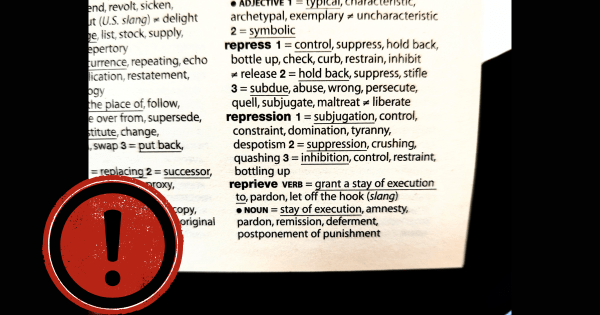
It is safe to say that the term repression has been rather dirtied since the emergence and popularisation of Freud’s psychoanalytical theories. When it comes to the human psyche and how we store memories, I quite like the third of Collins Thesaurus three definitions; to “subdue, abuse, wrong, persecute, quell, subjugate, maltreat” – opposites of ‘liberate’ (p. 237, 2008).

(Yes, I own a physical copy of the Collins Thesaurus because I am a big nerd. Also, I like the way it smells.)

I am writing this not to discuss or critique freudian views, but to have a closer look at what we know about these so-called repressed memories and, to some extent, the treatment of psychological symptoms that may be rooted in traumatic events, from which the brain decided to ‘quell’ the circumstances because it didn’t seem productive to dwell on them at the time of their occurrence.

Firstly, the repression of memories is largely understood as a defense mechanism. In my own words; the unconscious makes the conscious existence more tolerable by hiding something that may be too difficult to grasp, or even live with, when the event occurs. It is not a conscious decision to forget something – that would be ‘suppression’.

I found myself thinking a lot, when studying pedagogy and special education, that whenever my books or professors mentioned resilience in children, repression was part of the package. As in, resilience was synonymous with a natural ability to unconsciously ignore otherwise unbearable trauma by blocking out their occurrence. This may be true – I never managed to investigate outside of my notions – but I find that resilience is more of a fight or flight response in that it enables you to get through something. When the trauma turns into a prolonged event, however, there is no telling when or if you’ll come out of it.

I theorise that the above creates an accumulation of unwanted/repressed memories that in turn start to fester, ultimately manifesting as symptoms of depression, anxiety, paranoia, PTSD – a disease that makes every waking moment drip with existential fear – and no way of finding out where the symptoms stem from when the pressure is released and you finally have a second to sort your head out. Thus, you’ll find yourself in need of professional help. However, if you cannot explain to yourself what caused your view of the world, or your coping mechanisms, it is almost impossible to put into words and efficiently communicate that which is left of these events – mainly the ambiance, smells, the emotions you felt – to someone that can actually aid your becoming a functional adult.

I have struggled with this myself, in different scenarios, and I’ve also been very aware/fearful of the fact that the act of trying to bring forth a repressed memory can create an unreliable or ‘false’ memory due to the suggestive invocations facilitated during EMDR, or awaken something that one is not yet ready to deal with, at least not without accompanying memories to the event that may remain repressed after such a session. Psychology Today has an interesting article about the debate over repressed memories, where you can read more about how trying to force the re-emergence of a memory may not have the desired effect by clicking anywhere on this sentence. It’s an interesting read.

I found another article on the same site, where the headline simply read “There’s No Delete Button in the Human Psyche – Fortunately”, which is something that I found to be true this morning, when I was sent a document that highlighted something that I, from June 2002 and up until that moment, had absolutely no recollection of. What’s more, it dislodged a few other bits from the same time period. This is what possessed me to write about repression, rather than the topic I’d planned on writing about initially (just keep an eye on the blog next week – you’ll discover what that was then).

Our brain’s memory – our hard drive – can be a complex entity. I find that my own, very much like the Cloud or One Drive, oftentimes cannot be bothered telling me where it has stored something. It’s there, but elusive – it only shows up when I’m not paying attention – more often than not in the shape of a flashback that makes my whole day go topsy-turvy, spurred on by a familiar smell or scenario (or when I am trying to attach one of my most recently used files to an email, on my computer’s hard drive).

So, I think there’s certainly a link between repressed memories and childhood trauma. There is a good chance that we need to accept and acknowledge the fact that these memories remain inside of our brains as shadows, rather than perhaps trying to force them to come out, in order to heal our repressed adult selves. And I am sure there is no universal solution to how one should go about it either. But I reckon finding a professional hand to hold for the especially bumpy parts of the winding road that life can be is as good advice as any.

You can read more about repressed memory and false memory by clicking this sentence.

Learn more about Repressed trauma by clicking this one.

I also have a theory about the connection between repression and Alzheimer’s disease, but we will have to save that for another day.

As always, please go check out my book if you enjoyed my writing – you might like it.

I’ll leave you with a link to a YouTube video of one of the finest songs ever to be performed in a musical, by the great Elaine Paige.

See you next Tuesday!

Lessons loss taught me

This past Sunday marked the 30th anniversary of the death of someone very dear to me. Thirty years gone, and my grief is so tremendous, still, that it manages to throw me off balance and send me straight into the void of darkness. Surely, that’s not healthy? It never used to bother me before – back when my entire existence consisted of me wallowing in my putrid pigsty of pain – but as that’s no longer an option, I’ve been tempted into a little research project to find out if my current suspicion can be backed by science.

My theory is this; being unable to grieve properly at the time has affected how I deal with feelings in general and thus stunted my emotional growth. I am sure that a lot can be learned from the experience of losing a loved one and dealing with the loss. As cheesy as it may sound, I am curious to find out if allowing myself to feel will help me heal. I think it just might be instrumental.

There are a million articles online about how important the grieving process is, but I think the way writer Jon Scalabrini articulates the detrimental effects of suppressing or not acknowledging certain feelings in his article on Peacefully.com illustrates my understanding perfectly and succinctly:

“By avoiding emotions, one creates future challenges; thus, “moving on” in the short term ultimately creates long-term difficulties.”

You can read the article in full by clicking anywhere on this sentence.

In my case, I was forced to move on too quickly due to matters outside of my control. This taught me – and my subconscious – that my feelings were not valid or important and therefore should not be acknowledged. My black and white thinking made sure this would be applied to all future scenarios where I’d be likely to feel strongly about something – or someone – in any way. I was unable to see how this could be circumstantial. So, to make things easier for myself and everyone else, I adapted. Or, likely overcorrected. I adopted a few terrible coping mechanisms once I entered young adulthood, which have continued to block my path to enlightenment.

I feel as if this is something that I need to un-learn, so I was delighted to find an episode from the American Psychological Association’s podcast series Speaking of Psychology, where interviewee Dr. Mary-Frances O’Connor, an associate professor of psychology at the University of Arizona, spoke about her studies on grief and grieving and how grieving can be a form of learning, among other things. The episode is called How grieving changes the brain and is available on the APA’s website, as well as on podcast streaming platforms.

I was not so delighted, however, to find that I likely suffer from prolonged grief disorder. Oh well, I’m sure there is CBT for that. Anyway.

O’Connor goes on to explain how the grieving process involves having to learn to live our lives without the person we’ve lost in it, that we need to find out who we are, now that the world around us has changed in such a profound way. It’s a rewiring of the brain – a learning process. Neuroplasticity. It’s a very interesting episode, as they go into the difference between grief and grieving, links to depression and different types of therapy that can help with the grieving process.

My main take from the episode, to benefit the validity of my theory, is that we must acknowledge the feelings we are experiencing for us to go through the process and come out on the other side of it stronger than we were when we went in. It is my understanding that avoidance is the opposite of helpful if we want to learn and ultimately move on. And accepting a loss as reality does not mean that we have to stop loving the person they were when they were still here, but that we cannot let that loss or its circumstances dictate how we live our lives from that point on. We need to accept the fact that it is okay to love again, whilst realising how a new love does not take away from the old one. Moving on does not mean that we have to forget, but perhaps – with time – we can learn how to look back at the fond memories that made us cherish them so, instead of clinging to the sadness and the trauma we experienced when they were taken from us.

Now, back to those “long-term difficulties” from the Scalabrini quote. My experience taught me that I was worthless. A deep emotional wound that has kept growing and festered over the years, by giving me the gift of trust issues, self-deprecating behaviour and self-sabotage, and only allowing myself to “feel” or emote when I’ve had enough alcohol to justify letting the tears stream freely down my face. I’d schedule my emotive cries, so not to become emotional in public. But by doing this with my painful emotions, my brain would of course apply this to any positive feelings as well, meaning that I wouldn’t allow myself to acknowledge any feelings of happiness either.

It’s a lot easier to convince yourself that you’re unlovable, than it is to remain hopeful that someone will one day actually think you’re something other than a huge piece of shite. Unless you start administering some much needed self-care post-haste.

I think, based on what I’ve learned today, that my theory holds up. What’s more – because of this – I now realise that it is not too late to start rewiring my brain so that I can make my way through the final stage of the process of my prolonged grief. Acknowledging the feelings, accepting the loss and starting to look at how my life would be different if I wasn’t so gung ho on treating everything based on something I interpreted incorrectly three decades ago are all parts of the healing process.

Never let anyone tell you how you should or should not feel – it can only lead to bad things, as we’ve learned from my previous post on the importance of having your emotions validated.

That’s it for today. Buy my book! See you next Tuesday.

Blog at WordPress.com.

Up ↑