Hume-our me or go Home: a minute of your time for some chat about passionate reasoning

Now, as a young first-year Philosophy student, I must admit I was never partial to David Hume’s school of thought (although I did find it funny that he supposedly changed his name from Home to Hume, because “no-one in England went by Home”. Pretty far-out behaviour, for someone from Lawnmarket, Edinburgh.

Looks like the drugs are finally out of the system – let’s celebrate the return of my ever-charming personality!

So, why the hell would someone in their right mind all of a sudden start reading Hume, when they already know they won’t like it? Next-level asceticism? The short answer is no, this was not an act of self-harm. In fact, I’ve not been reading at all – he was quoted (if only very briefly) in a podcast episode. I cannot for the life of me recall what podcast this was, and I refuse to go through the log on my streaming app, seeing as I’ve listened to hours and hours of music since. But I know it had something to do with reasoning and causation.

The original (and full) quote is from section 3 of the third part of the second book in Hume’s A Treatise of Human Nature. It is grossly taken out of context – much akin to a headline from The Sun – and reads as follows:

Reason is, and ought only to be the slave of the passions, and can never pretend to any other office than to serve and obey them.” (1739-40)

The quote is often seen in combination with another part of the text so far down on the same page that you have to assume the latter works as a sort of book-end to the former, after a series of examples of how the ‘self’ defines reasoning driven by passion. The latter does not follow the former without some degree of detailed explanation. You can read the entire thing by clicking anywhere on this sentence.

Now, feel free to call me on my jumping onto the express train to judgement city, but I’ve spent enough time behind semi-dodgy boozer bars to recognise the drunken ramblings of a grown man with certain, shall we say, repressed urges.

Nevertheless, it turns out the 2026 version of me actually quite likes these musings of Hume. And, what resonated was the part about our passions bleeding into our reasoning – and not only in matters of the heart. What are we, without passion? To me, life would have very little meaning without it. The joy you feel when a risky venture pays off. The slack you might cut yourself if it doesn’t, because the passion drove you to act carelessly.

I believe that any human creature capable of emotion can be passionate about a multitude of things. I mean, need I bring up the bog roll conflict?

When shit gets, well, real shitty, my passion-fuelled reasoning is the only thing that can shift my focus. Albeit not always in a good way, but still. Just like a limp handshake, a passion-less existence is not for me. Which might be why antidepressants only make me unwell – I need the passion to feel alive. I thrive on the chaos I’ve created, because I lets me access this superhuman stress-tolerance in the event that real chaos erupts. When you flip the switch, however, just crossing the street might feel overwhelming.

If you ever feel overwhelmed, dear reader – or if you’ve had enough of these seemingly unstructured ramblings – I’d like for you to drop me a message via the contact form. I’ve got loads of ideas, but I’m up for a challenge. Finally! 10 points goes to the first person that manages to stump me.

I am going to love you and leave you for now. I shall see you again next Tuesday!

Until then, this video had me mesmerised for so long I lost track of time the other day… Enjoy responsibly (by clicking on this paragraph, or get your ya-yas out to the embedded video below).

Discontinuation depersonalisation

“Shivering, muscle pain, fatigue, excessive sweating, headaches, weakness, vertigo, gait imbalance, dizziness, ataxia, tremors, paraesthesia, nausea, vomiting, diarrhoea, abdominal pain, electric-shock-like experiences in the brain (referred to as brain zaps), visual disturbances, insomnia, vivid dreams, nightmares, agitation, irritability, anxiety, tearfulness, sexual dysfunctions” (Special Issue Psychopharmacology of Affective Disorders, 2021) – these are a few of my favourite things.

I jest, of course. You’d be hard pressed to find so much as one of these things anywhere even remotely near the list of things I’d wish on my worst enemy (apart from maybe the diarrhoea), yet they are some of the more common symptoms associated with the discontinuation of the ‘serotonin modulator and stimulator’ (a type of antidepressant) Vortioxetine.

Other research studies mentioned such lovely side effects as depersonalisation, emotional incontinence and the inevitable return of the depressive symptoms.

Needless to say, I stopped taking my meds due to their inefficacy and rather intolerable, to me, side effects (I have an intolerance to certain types of medication, and I am not claiming this to be some sort of universal fact or that all drugs are bad. This is just my personal experience.), and now I’ve gone a bit extra bonkers. I’ve been so out of it, it didn’t even occur to me that it could be withdrawal symptoms (I was on a very low dose to begin with, and tapering is not normally necessary), until it was pointed out to me by a professional.

The good news is that it’s not permanent. One day, I’ll be less likely to start greetin’ like a wee bairn whenever I hear any hit song from 1995, and I can get through a whole day without feeling as if I’m only observing my physical body from another realm hidden by a thickening veil… Perhaps one day I’ll be a little less pretentious-sounding as well.

Anyway, my recent lack of inspiration and focus has an explanation. My brain will resume its brain-like activities yet again – soon, even. Multiple trusted internet sources tell me that I am at around the time where the more adverse symptoms reach their climax (YUCK), and that I can expect them to taper off and (hopefully) disappear within the next fortnight.

Just knowing that there’s some logic behind my very odd behaviour in recent weeks helps a great deal – I’m sure I’ll be back to writing fascinating content about, say, how far a human fart can travel before losing speed, aroma or altitude in no time. Perhaps even next week?? You know you’re in for a treat – here’s hoping no one will steal my idea whilst I’m contemplating my existence, the meaning behind the lyrics to Tears for Fear’s Shout, or the secret behind Michael Hutchence‘s incredible charisma.

I dare you to click on the above ‘fart’ link.

Whilst my synapses have been frying themselves in the last drops of oil meant for lubricating my myelin sheaths, and my prefrontal cortex has fucked off on an all-inclusive EasyJet holiday to Lanza-fucking-rote, the world has been burning. But, at the same time, people seem to be finally waking up. I’ve noticed more people spending less time on their phones on public transport this past week, making eye contact and even smiling (!) at strangers. Perhaps there’s hope for our species yet? If not, I’d better hurry the fuck up and finish the second book before we all go *poof*.

Regardless, I’m pretty sure I’ll see you next Tuesday. Until then, you can read this post that I wrote about something absurd, or you can listen to one of the finest NWOBHM albums of all time, Killers, on YouTube.

Time is running out

Frankly, if I’d owned a blimp or some sort of rocket ship, I’d be running too. Out, up and beyond. Over the hills and far away will no longer suffice, mark my words. Like a phallic metallic turd, I’d be blasting into space at full throttle. The hills are of little use to me now, for they are dead, with the sound of silence. Where did all the good people go? What happened with wanting to heal the world, make it a better place? What becomes of the broken-hearted?!

So many questions, so little time… So many links, to the songs mentioned above, in the titles. The clock tickens, as nine year old me might have said, having no clue as to how or why one would ‘thicken’ a plot. I like my version better, so the clock tickens it is.

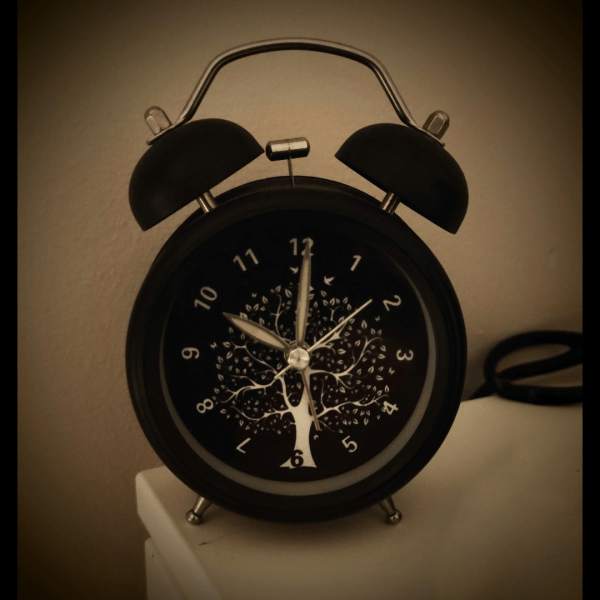
The alarm clock in the photo is the loudest thing in the world. In fact, it likely raises the dead, but I live too close to the graveyard to dare have a peek through the curtains just after the alarm’s gone off. It really is everything louder than everything else. Motörhead.

You might be wondering by now, if these are the ramblings of a woman gone completely bonkers. That my brain has become the dish that ran away with the spoon. (Mystery link!) I don’t know what to tell you – it’s just one of those days where I found myself shouting at my phone to ‘shut the fuck up’ over and over until it stopped ringing, rather than just hanging up. Surely, that happens to all of us, right?

If I’m the only one, please, feel free to have a chuckle on my behalf. I’m sure it looked and sounded pretty funny to the recently undead that were kicking about in the garden at the time. (Alarm clock, remember?). The thing is, it’s just stress. And the more stressed I get, the foggier my brain. I woke up mid-vomit this morning, terrified of having overslept. All I can say is, thank fuck no one’s here to witness it all.

What can possible be so stressful that it makes me throw up in my sleep, you might ask? Life, my friend. Life is stressful. And, had I just dealt with the one thing that kept getting in the way of everything else when I first noticed the pattern, I may have been able to avert the chaos. Instead, I left it to fester, and now even the slightest inconvenience (accidentally placing the loo roll the wrong way around, anyone?) will throw me off my already weakened game. Which brings us back to time.

Time wasted on avoiding the menial tasks on my to-do list by starting new projects. Time wasted on negative self-talk due to having begun said projects. Time wasted on being annoyed with shit that’s beyond my control. Who wants to control everything anyway? Because, ultimately, attempting to control something or someone is a futile gesture indeed. The only thing you can control is your own perspective, if that. But my perspective is bound to be tinted by my past experiences, my situation or my expectations. What caused me to view X as Y, et cetera. There’s no control.

If you want to get into the metaphysics of causation, you can head over to the Stanford University Philosophy Encyclopaedia and have a gander.

People are so hung up on who’s to blame for something, but they’d rather spend time discussing the big, horrible thing than actually doing something about it. Because, if the scapegoat goes away… how will they know for certain that they wouldn’t get the blame themselves the next time?

And I’m now wasting precious time thinking about what I want to write about next week. All I can tell you is that it’ll likely be a little more structured than this. But certainly not rant free! You’ve been warned.

Pending finally being able to manage the 15(!) remaining pages of the book that’s been eating away at my sanity since mid-November, I shall see you next Tuesday!

Until then, buy my book, or perhaps give me a shout via the contact form. Like Arnold used to say in his Pump Club podcast: “I want to hear from you”.

The unavoidable convergence of kindred energies

In the not too distant past, I said I’d write something about friendship. But then life happened and the flames died down, leaving nothing but an ember behind. Well, the wait is over, because someone stoked the fire into a mighty roar!

If you manage to read through the whole thing, I’ll include the very words that inspired me at the bottom of this page.

All my life, I’ve flitted from loner to loner like a very busy little people-pleasing bee, trying to find matches for those who seek me out. Not bothering to seek out people I’d consider a good match for myself, of course, because that’s far too scary. (Also, I never planned on being around for very long in the first place, so why bother).

Regardless.

I wound up becoming everyone’s pal and confidante, but without having any real pals of my own. And with my constant need to be everyone’s best friend, I was ultimately an unpaid agony aunt-cum-matchmaker.

(Boo-hoo, poor me! Relax, it’s not that kind of post). But, if you’re in the mood for something a little darker, head on over to another one of my posts here, or buy my book.

I did get to a point, though, where I’d had it with the upkeep of these one-sided, fair-weather friendships, and I’d have to move far away and/or burn all bridges as thoroughly as humanly possible. As it turns out, you simply cannot rid yourself of a real pal that way.

I’ve known my very best friend for 30 years, and it’s the most effortless human relationship I’ve ever had. That’s not to say that we don’t go all in for each other when needs be – because we do – but it doesn’t feel like work. I know she doesn’t expect anything from me, and vice versa. We’re not afraid to say what we mean to each other, because there’s an unconditional love tying us together. She’s been there for me through some really horrible shit, and she’s still there – she must be nuts. But she’s my nutter.

The interesting thing here, though, is that we’ve lived hundreds of miles apart for the better part of those 30 years. For the longest time, I suspected this physical distance to be the only reason anyone would ever stay friends with me for any longer than a few boozy hours down the pub. These days, however, I’ve realised that’s not the case.

The pandemic probably helped change my mindset as well. In Edinburgh, we didn’t really have the opportunity to socialise the way we used to- at least not face-to-face – so if you did reach out to someone, it was out of a genuine wish to interact with that particular friend. And even now, as I live miles and miles away from my home, these guys are the ones I speak to more regularly than the people sat next to me in the office every day. And, as it turns out (with one or two exceptions in my geographical proximity), the friends I’ve made that are scattered all over the globe, are the ones I consider my closest.

What might have started out as a need to protect myself from the potential hurt of losing a friend has ended up being a sort of confirmation that I am worthy of being someone they’d want to keep in their lives. And the other way around.

Apparently, there’s something about ADHD and challenges with adult friendships worth researching, but I think all adult friendships require something more. They need to challenge you, to sustain you, to elevate you and keep you grounded, to enable you to see your own story from a different perspective when you’re stuck in a downward spiral (or a narcissistic doom loop, for that matter), and you need to be that for someone else as well.

My plan was to research this properly, because I came across a podcast episode on this. Not just one, to be fair. There are hundreds. But this one seemed like the real deal. I’ve yet to listen to it, so I’ll share the link below so we can all listen to it together.

And, as promised, I will now share the inspirational words of Mr. B (with his permission, of course). This, to me, is what friendship is all about. I consider myself to be very fortunate to have been on the receiving end of these words:

I share with you the strive to do better, to be better

I share self-loathing and self-sabotage

I share self awareness.

I share distrust of others.

I share utter devotion to the (very) few.

See you next Tuesday. Drop me an email if you have a topic you’d like me to write about!

Creative differences

If you consider yourself to be a creative person, I am willing to bet you have also found yourself staring so deep into the abyss on enough occasions to either having sat across from a mental health professional at some point in your life, or someone has pointed out to you that maybe that would be a good idea. Regardless, you’ve had a chance to consider whether or not medication is for you. And many of us tend to opt out. We’d rather live with crippling depression, biweekly panic attacks, compulsions and partner-repelling mood swings than potentially lose the one thing that makes our existence make sense; our creativity.

Let me just pause for a second to let you know that I am aware that this is a myth that’s been thoroughly busted. You can read about this and other SSRI related myths by clicking on this sentence.

Still, it’s a very real fear that needs to be acknowledged. If you cannot fathom why, this post is not for you. Go read something else. I can recommend my book. Or, if you have yet to listen to Rob Halford’s autobiography on Audible, you should go do that. It is fantastic.

If you do know what I’m talking about, though, you’d be very interested in what I heard in a podcast I listened to recently… What we (us mental patients of the neuro-spicy kind) mean by creativity in this scenario is not necessarily how it’s perceived by the people prescribing the meds. On the contrary, when we state our fear of losing our creativity as the main reason were so sceptical, they seem to think our meaning is that we’re afraid we’ll lose the ability to think outside the box. I.e. they think that, by creativity, we mean creative thinking, in regards to problem solving.

Whereas most of us mean the ability to create something unique, freely and without template, fuelled only by an inner compulsion to create. Essentially, its our life force; what makes us us.

Perhaps we should’ve used the word imagination instead. But, it’s not on us. As defined in most thesauruses and dictionaries, creativity is “artistic or intellectual inventiveness”. Yet, in a post found on Psychology Today, we see another example of the writer seemingly focussing on the problem solving aspect rather than the imaginative.

I would be remiss if I’d concluded that all mental health professionals are of the same opinion as this single writer and the neurologist from the podcast, but I do think that it’s worth noting that the person being prescribed the medication might not be equally as immersed in the DSM diagnostics sociolect as the person holding the prescription pad.

It is a myth, though. SSRIs or ADHD meds won’t kill your creative ability (although some SSRIs may cause brainfog, but most ADHDers experience that regardless).

Some lyricists may fear that they can only truly write when they’re depressed, because that’s when they’re the most connected to their emotions or whatever. That’s a load of bollocks. You can certainly learn from depressive episodes, but being depressed isn’t going to make you the next Bob Dylan – if that were the case, you could get the same effect from downing a bottle of red. If you’re really talented, though, you don’t need any of that shit – the talent is part of your personality. And, as far as I know, they have yet to make any FDA approved personality altering drug.

There are logical solutions to creative blocks as well – we’re just too impatient to admit it.

That’s it for today. I reckon my next pist might be real morbid. (Or I might go down a panic attack related wormhole, full gonzo).

Either way, see you next Tuesday!

Also, the featured photo is of one of my favourite paintings, ever, found in the Voodoo Museum in New Orleans (quite possibly a Voodoo Charlie original). If you’re ever down NOLA way, you should check it out.

Grievances from a shallow grave

I never quite managed to tell The Tell-tale Heart and Death of a Salesman apart – or the latter from Fiddler on the Roof, for that matter – I was so bored out of my skull from all the pretentiousness that I somehow blocked out the differences. I’d rather read The Salesman Fiddler Tell-all (Death on the Roof). (I mean, who wouldn’t?)

What’s this got to do with the price of moth-eaten stockings? Well. All three of the aforementioned works of fiction (one would assume) are quite dark. And being introduced to them during my hormone-infested formative years, when I was already submerged in thoughts about the frailty of the human body, they all seemed to embody the same message; death will come for us all. I suspect that’s when I first decided that I wasn’t going to let death take me by surprise – I was going out on my own terms.

And, thus, my fear of death was born. Much thanks to the flawed human psyche. I wanted to finish myself off. I had made my peace with dying, but I had a few things to tick off my list before I could escort myself off the ledge, as it were. I didn’t dare to sleep, in sheer fear of never waking up again. (Which eventually resulted in fainting from the exhaustion, but you’d be surprised at just how long a stubborn child can manage to stay awake if left to their own angst-ridden devices). Thanatophobia, for you learned folks.

I know I promised you a post about suicide and friendship, but I changed my mind. And then, as I was running through a graveyard to catch a bus yesterday, I started thinking about the link between death anxiety and suicidal ideation – surely there must be one. But now I cannot find any research on the matter, so I am hoping this finds its way to a person in the position to do a proper study on it. In the meantime, you can read about “Attempted suicide and Death Anxiety” on the American National Library of Medicine. It was the only thing slightly scientific, not in a Reddit thread.

And instead, I will give you my two cents on how forced time off work/paid seasonal leave can lead to burnout if you have fallen out of love with your job. I’m not talking about going away on holiday here, I am talking about being faced with whole days completely without team meetings, work calls, the constant need to check your phone for notifications and the endless to-do-lists, and you haven’t had to ask for it.

Most people will enjoy the time off, fill it with family activities, festive pish, a Tinder-palooza if so inclined, and some might feel a bit anxious about not being able to respond to emails, or they didn’t manage to get everything done before they left the office on the last day, but even those people will be able to relax after a few days have gone by without any disasters. And, depending of just how many days one is awarded off, some of these people might start to notice how their sleep pattern improves. Some might notice a slight weight loss, their complexion clears up, all of a sudden, it’s been a full week without them reaching for a single Paracetamol. But they might think very little of it – they might even brush it off as them finally starting to get over that cold that somehow came over them mid-October and never quite left.

But then, as if by magic (or, rather, a curse), the last day of the holiday arrives and they unable to fall asleep, because they’re terrified the alarm won’t wake them, so they pass out some time around 1am, only to wake up in a pool of sweat two hours later, which then has them twisting and turning until about 40 minutes before the alarm’s set to go off, when they finally fall asleep. One alarm and five snoozes later, they’re standing in front of the bathroom mirror, wondering what has happened to the person looking back at them the day before, when they hadn’t even needed an alarm to get them out of bed by 6. The week is off to a shitty start, and when they get to the office, they are inundated by emails they are unable to respond to, because of the incessant post-hols chatter between the more cheerful colleagues, who have been looking forward to seeing everyone again (and no doubt get to see a little less of their respective families). So, little by little, the sleep-deprived shell of a human being just sits there, staring into their computer screen(s) looking for the meaning of life, as the first headache starts to brew, accompanied by a fever and a slightly elevated heartrate from the stress. This, of course, is followed by nausea, but at the same time they are overcome by a seemingly insatiable hunger – they can feel their body expanding just at the thought of food… If this is you? I have one word for you; burnout.

We don’t talk enough about the physical symptoms of burnout, or the detrimental effect it can have on our everyday. There is a chance that a change of scenery can fix it, but, regardless, you can benefit greatly from seeing your GP about this. Just talking about it with a professional can be a tremendous help. This is your body screaming at you to stop what you’re doing and tend to it before it shrivels up and dies a slow, painful death. Or, if you’re just dying to leave a cortisol-filled middle-aged corpse behind, continue ignoring it.

If the prospect of going to work feels like a fate worse than death and fills you with dread – or worse, with indifference – you might want to update your LinkedIn profile…

I leave you today, with the immortal words from Clare Harner’s 1934 poem Immortality, as published in the December issue of poetry magazine The Gypsy:

Do not stand
          By my grave, and weep.
     I am not there,
          I do not sleep —
I am the thousand winds that blow
I am the diamond glints in snow
I am the sunlight on ripened grain,
I am the gentle, autumn rain.
As you awake with morning’s hush,
I am the swift, up-flinging rush
Of quiet birds in circling flight,
I am the day transcending night.
     Do not stand
          By my grave, and cry—
     I am not there,
          I did not die.

Because, I am not there. I did not die. I just listened to my body and managed to get myself pulled out of the abyss before I was buried alive. Now, go buy my book, please. Or, you could send me a wee message! See you next Tuesday.

Why you should say f*ck off to faking it

Today, I’ll start by giving you a choice; you can see this post as the trivial, banal waffle of a fortysomething spinster, or as a welcome distraction to the soon to be if not already 3rd world war currently monopolising every news broadcast out there. Regardless of your choice, please be aware that I will now be diving straight into a rant, in an attempt to escape the harsher realities of my own existence.

If you’d like something more palatable, I suggest you go watch this episode of Banana Man on YouTube – you can do so by clicking anywhere on this sentence. It is quite delightful. Also, made by actual human beings using their actual minds. Even the voices are real.

Or you can pass START without collecting 100 dollars and instead spend a fiver supporting the poor by clicking on this one.

Don’t say I didn’t warn you.

We’ve all heard the phrase ‘fake it until you make it’, but as dishonest as such an approach may be – at least it used to come from a place of needing to accomplish something (and more often than not, the fakery came with a valuable learning experience or two). With the rise of AI, however, the faking has become the norm, and what’s more, no one seems to see the need to learn anything, even when it comes to developing a personality. What was initially designed to be a helpful tool to help develop ideas has become the thing that surely will eradicate both art and empathy in modern society. I’m not presenting this as fact, but I’d say it’s a rational fear at the very least. By faking your way through life using nowt but shortcuts and with no desire to add to your skillset, you’re not only lying to the people that have to suffer through your incompetence – you’re lying to yourself. It’s the ultimate injustice. And if there’s one thing I’ve learned about myself (and that this is a common trait for neurodivergent folks), it’s that I cannot stand injustice. Thus, there is no way that faking it to get ahead is the best solution for us.

To those who still don’t get it, I ask you this; what will you do once you reach the proverbial top? You’ve faked your way there and learned fuck all along the way. How the hell do you expect to carry on the charade?

I have chosen this particular topic, as I keep finding myself in positions where I am meant to pick up the ball from where one of these fakers left it, with no trace of them having done any actual work. In one such scenario, I kept asking for an overview of the processes and tasks I was to become responsible for in their absence, and was (after almost a month) presented with a list of links and a Word document with instructions for using software in which I am already proficient. Me being me, I thought I shouldn’t knock it before trying – maybe they had a better way of doing things – but I soon found myself stumped by the inaccuracy of the instructions. So, of course I asked them to clarify. (I’ve been wrong enough times in my life to know better than pretending to get it…). At which they simply replied; ‘oh, it’s easy, I just asked ChatGPT and jotted down the response for you’. No wonder the ‘quick fix’ tips did fuck all!

At least, with a paid version AI, you can get some decent guidelines, but you should probably run a few tests before listing them in an on-boarding document, eh? Also, I’d much rather do a non-assisted search to find three credible sources and take it from there, instead of having to fact-check anything generated by artificial intelligence.

I know I could’ve let this go – perhaps even should’ve, but I ended up wasting so much of my time trying to make use of the so-called instructions (and doubting myself) that I just couldn’t. It would have been better to just crack on the way I always do, and to revise my textbooks and course videos if and when I’d get stuck.

Over the past few years, I’ve seen so much of this and I’ve had enough. Why should people like me get punished for wanting to do the work and, for instance, writing my own CV and cover letter, when fakers, who’d rather sit all day and chat about what colour they’re going to paint the nursery than doing any actual work, get all the jobs they apply for because they don’t bother fact-checking the lies the AI bot has produced by creating a text out of their poorly worded bullet points? GAH.

Hear me when I say that I am quite irate. You’ve poked the bear one too many times. And this is much, much bigger than me being annoyed at lazy fakers.

Imagine, if you will, that something truly horrible happened to you – a crippling illness, or you were wrongfully accused and incarcerated for murder – would you trust a doctor or a public defender that “got “earned” their qualifications by taking shortcuts? Or, if all of the pipes in your house suddenly burst and needed replacing in the middle of winter, would you trust yourself or a partner using AI and YouTube videos to fix it over a certified plumber?

I certainly hope not.

So, what’s this to do with mental health? I hear you ask. Everything, I say.

Initially, I’d left myself a note to write and research how faking it rarely works for those with ADHD and a side of rejection and/or justice sensitivity. You can read more about this in Amelia Kelley (PhD)’s article on Psychology Today: How justice sensitivity amplifies world issues for ADHD.

I didn’t realise this was a thing until I got diagnosed – I’d just always thought I had a strong sense of justice. This helped explain a few things, but mostly why it felt so unnatural and just wrong for me to be faking anything. It’s like lying to yourself, and our need for justice will help our subconscious see through the lies, so we’ll end up feeling as if we’ve effectively tried to pull one over on ourselves. It’s like masking, but when we really don’t have to – or even should. (One could argue that you should never try to hide who you really are, but hey).

Which brings me to the scary, and most of all really quite harmful, side effect of masking: SKILL REGRESSION; defined on Psychology Today as “behavioural “backtracking” or reversion to earlier coping mechanisms that can occur as people progress through different stages of development”.

This was explained in much simpler terms in a podcast episode I listened to the other day (link at the very end of this post), as the regression of skills you learned while masking. Once you get treated for your symptoms and no longer need to mask, some of these skills may even need to be relearned and new neural pathways need to be constructed to help locate the seemingly forgotten skill. (Thank fuck for neuroplasticity, eh?). I wonder if this works for repressed memories as well. Who knows.

Anyway, I am at the end of my rope here and I need to get ready for work. I promised you a link, so enjoy this episode of Hypercast by clicking on the Spotify link below.

See you next Tuesday! There may or may not be a post on suicide recovery and friendship. Stay tuned.

Finding calm with a busy brain

I took this photo at a gig this weekend, just as the shutter on my camera stopped working properly – hence the blur. Not a great thing to have happen mid-show. Alas, when I was going through the hundreds of images I had uploaded from my trusty Canon onto my desktop in the hope of finding something usable, my heart jumped a little at this particular photo. THIS is what my brain feels like when I’m told to be quiet or to sit still for any undisclosed length of time. It might resemble noise pollution to most, but, to me, it is more akin to an everchanging tapestry of neurons firing and processor overload.

If you, like me, have a slightly over-active mind, where there’s no end to the constant chatter going on behind your eyes, you may have been guilty of rolling your eyes so hard at the mention of the word ‘meditation’ that you’ve given yourself a headache on more than one occasion. Like trying to silence the voices in your head whilst sitting completely still for who knows how long is going to be anything other than a gigantic waste of time. Because, as we all know, this is how it works; the road to enlightenment/serenity is awarded only those who can shut down completely, sit in a lotus position for hours on end, breathe in and out in a pattern of inhalation for four seconds, hold for four, exhale for seven, without getting caught up in the counting, stop thinking about anything other than roots springing out of your arse and into the centre of mother earth (and also avoiding thinking resentful thoughts brought on by the word mother), be oblivious to the fact that the earth’s centre is filled with lava that will surely burn your rectal roots and not ground them, all the while trying to keep your eyes closed and not check the time every five seconds, to make sure you’ve counted your breathing seconds correctly. WRONG!

This might be how traditional meditation has been presented to most of us through books, films, YouTube channels and podcasts, and “everyone” all claim that meditation is “great” for people with ADHD, but no one’s ever bothered to tell us why it’s so great, shared with us the philosophy behind it, or let us know that there aren’t really any rules to how you should meditate. Turns out, you don’t even need to keep your eyes closed!

If you started reading this under the misapprehension that it would be another well-researched post filled with interesting links, I apologise. I’ve been under so much stress lately that I’ve been searching rather desperately for anything that could help, so when I came across this random podcast episode where they were discussing ADHD and meditation, I didn’t remember to bookmark it for later. (Very clever, I know). But the general gist of it, I remember, because the host and their guest confirmed something that I have been theorising for quite some time; that meditation can be relative to the person doing the meditation.

Let me explain for a second: I find running meditative, especially when I go hard enough that my body becomes so tired that I can no longer stop my thoughts from flowing freely, which in turn brings forth many a solution to any conundrums I have had in the past. If I need to sort something out, that I can’t get my head around, or have an impossible deadline and keep procrastinating, I go for a long run, aiming for a PB. That works for me. I’ve tried sooooo many guided meditations, both live and to recordings, and all they do is stress me out. There’s too many rules! And how am I meant to find inner peace when people keep breathing, or the so-called guide keeps mispronouncing certain words or saying nonsensical things? Why can’t they just shut the fuck up so I can collect my thoughts for a second? Oh, I’m meant to “empty my mind and let go of what no longer serves me”. Right. How about giving me a goddamned second to think about what that might be? Oh, we’re manifesting now. Okay. What the fuck? I need to do things my way.

Needless to say, I was more than relieved when I heard the aforementioned episode, because – like many others with ADHD – I need confirmation on certain things. I need to know I’m doing things correctly. (It’s a miracle that I ever manage to walk anywhere without overthinking my every step, because no one has ever confirmed that I’m following the foot placement recipe correctly).

So, I thought I’d share this with whoever else out there needs it. It gave me some piece of mind and I am allowing myself to stop torturing myself with the biweekly guided meditation pod I’ve been following for the past three years. That’s more than 39 hours of time wasted… but it could have become a lot more had I not realised that I can meditate in the way that I see fit.

So, what is the purpose of meditation? I like what I found on study.com: “Meditation is an act of connecting the mind and body to the present moment.”

They also list seven different types of meditation, in which we find ‘movement meditation’. I feel like so many have focussed on the relaxation aspect of mindfulness meditation, that it’s become ingrained in our culture that we need to be half-asleep in order to connect with our truth. There is something to be said for the breath work in meditation, of course, but I don’t necessarily think that you would have to follow a pattern set by someone else. Do you have someone set the temperature for your shower as well? I certainly hope not. It can of course be helpful to have a look at different techniques and what works best for which type of meditation, but at the end of the day, your meditation practice needs to work for you. It’s precious alone time for you and your brain – even the busier kind!

To finalise, this is a time of year when there’s more unwanted noise coming from every angle than normal. Perhaps we can find a way to turn all that food noise, money noise, people noise into background noise by finding a small pocket of alone time in a day. Just five minute can be enough, this podcast told me – that’s less than an average poo!

And on that note, I bid you farewell for the last time in 2025. See you next Tuesday!

Oh – please buy my book. I am very poor and in need of a new camera.

Perhaps I’ll kick the new year off with an interview with an up and coming band from Norway’s metal scene… Keep your peepers peeled!

HAPPY NEW YEAR, MAY THE NEW ONE BE A BIT LESS SHIT.

Wee update! I found a great article on ADDitude.com, where they provide a detailed account of how you can make meditation part of your daily routine without too much hassle. Click anywhere on this sentence to read. Cheers!

Advert-induced holiday blues? Nein danke

Do you ever have one of those days where everything just seems to turn to shit, whatever you do and no matter how well-positioned you are to averting life’s many crises? Yeah, same here. And, somehow, their occurrence appears more bountiful the closer we edge towards to the 25th of December.

If you truly love Christmas, I urge you not to read this. I’m not in the business of trying to ruin things for people who don’t deserve it. Also, this is largely an opinion piece, with very few – if any – links to other sources. If you want something more well-researched and less opinionated, you can buy a copy of my book for yourself, as a wee crimbo gift.

Don’t say I didn’t warn you.

Everything is dark, cold and humid, every cunt on public transportation seems to have left their manners at home and are sneezing into each others gluttonous faces, without even as much as contemplating covering their mouths, and everyone is on a wild hunt for gifts for ungrateful (and very naughty) friends and family members. What was once a celebration of the birth of a bastard nail connoisseur has now become a competition of who can manage to chuck the most of their salary down the toilet in the quickest way possible.

I remember a time when any gifts were reserved for particularly well-behaved children – and often used to make particularly nefarious ones behave – and therefore not procured until after the child had upheld their end of the bargain. There were no guarantees. And if your parents were unable to afford a gift? Well, you’d go without. Perhaps you’d even treasure something homemade.

Today, on the other hand, once humble wishlists have been replaced by demands and shop registries, and friends and relatives of parents and parasite alike are told in no uncertain terms what to get them. The more you spend, the better. No surprises under the tree, and nothing that isn’t currently – or recently has been – trending on TikTok. Anyone not celebrating this atrocious holiday, for religious or economical reasons alike, are either forced to take part or shunned for refusing to spend money on something so appalling. Madness.

Don’t get me wrong – I actually love gift-giving. Hell, sometimes I even enjoy receiving them. BUT. Not just because it’s Christmas. I like to give people something from the heart, something special, so they’ll know that they, too, are special for receiving it. Sometimes that might be something I’ve made, or I’ve come across something that made me think of the person. It shouldn’t really matter. I don’t need someone else telling me what to buy for someone I love, and I don’t appreciate someone (or something) telling them that receiving something that’s not on their list is a bad thing.

It’s the goddamned adverts, man.

And it’s not just the blatant disregard of those who don’t have a whole lot of money to spend on something someone else will look at once before chucking it into a corner, never to be used or played with again. It’s the fact that these so-called Christmas adverts (why not call them what they are; the Q4 adverts? It’s not as if they are reserved for the last month of the year) sends the not-so-subliminal message that everyone has someone to spend the holidays with. Everyone can afford the foods, the treats, the fucking meaningless bloody decorations, the electric bill matched only by that of all of fucking Paris. And it is literally impossible to escape the madness, should you want (or need) to – the adverts are everywhere. On streaming services, public transportation, the supermarket, billboards and the blooming airport.

So, what does it do to those of us that simply have no time for this farce of a religious holiday? If you are a believer of the Christian faith, surely you must be appalled? The Christ mass has become nothing other than a golden calf. Then there’s those of us that for various reasons have no family of our own, or you have a non-related chosen family that does take part in the celebration. We’re normally used to, and most of us even quite content with, spending time alone, but now were bombarded with signs that there’s something wrong with us and that we are on the outside of society looking in.

Lifestyle by Homecare Services reported in 2024 that “1 in 4 adults in the UK feel lonely during the Christmas period. 52% of older people say that Christmas is the loneliest time of the year”. An article posted by Boise State University that same year, revealed that 61% of Americans experience “sadness and loneliness” during Christmas time. Imagine, if you may, how bad it must be for someone, when they’re ready to admit that. In fact, I am willing to bet that there’s at least another 10 per cent unaccounted for, in each of those surveys, that feel the same way but are not willing to subject themselves to scrutiny for revealing it.

Surely, you don’t feel any less lonely or sad when every time you go into the supermarket or a shopping centre, there’s Christmas music and images of people enjoying the holiday time and lots of people drinking and carolling and desperately clinging on to traditions that can be potentially harmful in the future, for our mental health, the economy and the environment. It just escalates the differences between us. It’s not ideal for anybody, not even those who are on the receiving end of your hard-earned money.

As you may have already gathered, around this time of year, I start thinking about what it will be like to spend Christmas on my own. A lot of us do – I’m under no illusion that I’m unique. Some of us may have chosen this ourselves, whereas others have not. And each year, if we are to believe the statistics presented in the articles above, there’s more of us. Some of us are… fine with this. I’d say most of us are fine with this, but then we’re bombarded with this illusion that everybody has to have that family connectedness, the food, the togetherness, which then leads our feeling as if we’re missing out on something.

I don’t have any solutions for this, other than trying to make my own little ritual and giving myself things to look forward to, that I can enjoy when “everyone else” is celebrating. And who’s to say you can’t celebrate on your own? Being alone doesn’t have to mean you can’t have a nice dinner and decorate your house. It’s just a little challenging to stand by your own conviction when you can’t even switch the radio on without getting Grinch-blamed.

Christmas is not my cup of tea. I don’t like the food noise, the greed, the fighting that comes from the consumerist fuckery, the endless need to numb the fact that you’ve spent more money on gifts for people whose names you can hardly remember than you have on the dentist in the past decade with alcohol… But I look forward to the things that I can do when no one else is around. I can sit down and watch a horror movie (or 10). I can go for a really long run and not have to worry about traffic. I can finally get some work done, because everybody else is off and I can do my work uninterrupted, or I can catch up with others like me. Or I can just learn to enjoy the solitude. I’ll just have to stay away from the TV, the adverts, the bus, the fucking shop, because they will get to you. They’re incessant and there’s constant noise.

And if I at some point hear the box of wine start calling my name, I thank fuck that the wine shop is closed for the hols and that I’ve got Bryony and Millie to keep me company – all I need to do is listen to their ADVERT FREE podcast episode on how to deal with all of the booze noise, and you can too if you click on this sentence.

You can read about how advertisers lure their way into your subconscious on Psychology Today by clicking this sentence.

Go to Mind.org.uk for tips on how to cope over the holidays, and learn more about others like yourself.

See you next Tuesday, for a shiny new rant.

In the meantime, you can listen to Bad Religion‘s Christmas album.

Is this love…

… that I’m feeling? Not bloody likely, research says. If you’re anything like me, that is. But as it turns out, I’m far from unique in this respect.

You might recognise the words above as lyrics from the 87′ Whitesnake hit ballad Is This Love – if not, you should click on this sentence to watch the original video on YouTube. My undying love (?) for David Coverdale is such that I have every intention of naming my dog after him, once I can get my hands on an Airedale Terrier. Regardless, it is a fantastic song, as all-encompassing as the feeling itself, and one I’ve wailed along to countless times. But was it really love that I felt all of those times, that led to my heartbreak? Or was it in fact limerence, which is more akin to symptoms of withdrawal than love. Whatever that is.

As you may probably already be acquainted with ‘love’, I won’t waste a lot of time going on about it. I’m quite fond of Strapping Young Lad‘s definition; “a way of feeling less alone“. Urban Dictionary has posted a few rather interesting definitions. One of the few I liked (you can read all of them by clicking here) goes as follows: “Love is beyond the ego. There is no ego when you love.”

The above is enough for me to assume that no one really knows how to define ‘love’. Perhaps it’s just one of those feelings that shouldn’t be analysed? Of course people had to go and shit on it by trying to pigeonhole it.

And then, of course, someone decided there is such a thing as a ‘one true love’ for everyone out there. Which resulted in a whole lot of entertaining film and literature, which a lot of people has taken to be something other than entertainment – perhaps even a sort of manual for how love works – and then went on to drill that into the heads of their unsuspecting offspring, leading to a lot of unnecessary heartache, resentment and social awkwardness.

See, the romantic relationships often presented in popular books and movies are so over the top you can’t help but be a little mesmerised. But surely you wouldn’t expect to find the Sam to your Annie on Tinder, swiping away and getting his leg over with every Tara, Doris and Helen, when he’s meant to be your one?

Art is meant to make you feel something, to give you a temporary escape from reality for an hour or two, or even be inspired to do something you’ve always wanted to – everyday life will very rarely give you that over the course of 300 pages or 90 minutes. So the main characters have to fall in love over a week’s time. Or at first sight. Or go from enemies to lovers seemingly by the drop of a hat – or pair of knickers. But that doesn’t mean it works that way in real life.

Things take time, for the most part. I am aware there are exceptions to the rule, but in most cases – and certainly with folks who tend to emotionally dysregulate – any instant fireworks are likely to be limerence and not much else. And that shit wears off faster than you can get rid of the STIs you contracted from hopping into bed (or onto the pub toilet) with mister/ms/they/them right within minutes after meeting them, because why would you need to use contraceptives if they are ‘the one’? That means they are practically a virgin, right? Or at least that you’re the only person they’ve ever managed to penetrate without any love gloves, right?

Wrong. In-cor-rectum.

I’m not saying I don’t believe in ‘the one’. In fact, I’d really like to think that there’s a person out there just for me. But if there is, I am a hundred percent sure that they won’t make me feel as if I am suffocating when I’m not breathing in the same air as him, that I’m missing a limb when we are apart, that I’ll die if he’ll ever leave me. Limerence makes you feel like that. And, despite my mother telling me it is “not possible to fall in love with someone who doesn’t feel the same way about you”. And so I walked the earth for a total of 41 and a bit years before realising that not everyone feels this way about things. Or, indeed, people.

So, I held on to the lies, until I rather recently naïvely exclaimed to a friend this summer: “You know, that feeling when you’re thirteen and have a crush on someone and you feel as if you’re gonna die – when you just know” – and they didn’t. Know, that is. In fact, they very gently but firmly informed me that this was a bit of a pink flag, if not all red. Which led me to purchase Kerry Cohen’s Crazy For You, through which I first came across the term (if you have a complicated relationship with love, I suggest you give this book a read).

Psychologist and love researcher Dorothy Tennov coined the term back in the 60s or 70s, to describe the intense infatuation or ‘love madness’ one can experience when it is not yet known if the romantic feelings are being reciprocated by the other person. This early phase of ‘love’ can be defined by symptoms such as “intense euphoria, a profound sense of emotional connection, mood swings, intrusive thoughts, over-arousal, obsessive infatuation and involuntary craving for the other person”.

More recent studies have shown this to be not uncommon, but for most people it wears off and develops into a real bond once a consenting relationship has been established. For others, like me, the unreciprocated obsession is often replaced by feelings of disgust or self-loathing. In any event the feelings are reciprocated, limerence wears off without turning into lasting love in about 18 months.

But this doesn’t just apply to romantic relationships. I get this feeling whenever I am faced with the prospect of something new and exciting, whether that’s a new job, a potential platonic friendship, a shiny new education, or something as banal as a packet of salt and vinegar flavoured Monster Munch.

Alas, when these feelings are not reciprocated (or my craving for the non-romantic prospects above remains unfulfilled), the poor limerent sod is left in a mental state that interferes with their day-to-day. An all-encompassing, undying desperation takes hold of the individual. Perhaps you miss work, because you are waiting up all night for them to call, or you spend all your savings on grand gestures to make them see that you mean business.

Hell, I once took off work, booked a flight and a hire car just because the person in question – whom I’d known for precisely one month by that point – doubted my ‘love’ for them. I’ve moved across the kingdom for someone I thought was ‘the one’, because they had mentioned, half-jokingly, that we’d probably be together if we didn’t live so far apart. (And, like me, they didn’t care much for the adventures of Harry Potter). I had 500 grams of Candy Corn shipped from the US, the special delivery alone costing me nearly 60£, just because I felt as if I couldn’t go another day without the flavour in my mouth. That’s not love. That’s obsession. Not like Stephen King’s Misery levels of obsession, but still. Close enough.

I’m not entirely sure where I was going with this – one can only assume that I felt inclined to explain my chosen singlehood in more scientific terms; I’m not getting myself into any more shit until I learn to differentiate between real attraction and, well, fatal attraction.

The jury might still be out on this one, but I am quite certain that I have yet to experience the privilege of being in love. Like never before, I find kinship and solace in the unforgettable words of Joni Mitchell:

It’s love’s illusions I recall, I really don’t know love at all

That’s it for now. I shall see you next Tuesday – if you’ve any topic suggestions for my next post, leave it in a comment below, or drop me a message on Instagram.

Oh – and check out my book, please xx

Blog at WordPress.com.

Up ↑