Blog

Discontinuation depersonalisation

“Shivering, muscle pain, fatigue, excessive sweating, headaches, weakness, vertigo, gait imbalance, dizziness, ataxia, tremors, paraesthesia, nausea, vomiting, diarrhoea, abdominal pain, electric-shock-like experiences in the brain (referred to as brain zaps), visual disturbances, insomnia, vivid dreams, nightmares, agitation, irritability, anxiety, tearfulness, sexual dysfunctions” (Special Issue Psychopharmacology of Affective Disorders, 2021) – these are a few of my favourite things.

I jest, of course. You’d be hard pressed to find so much as one of these things anywhere even remotely near the list of things I’d wish on my worst enemy (apart from maybe the diarrhoea), yet they are some of the more common symptoms associated with the discontinuation of the ‘serotonin modulator and stimulator’ (a type of antidepressant) Vortioxetine.

Other research studies mentioned such lovely side effects as depersonalisation, emotional incontinence and the inevitable return of the depressive symptoms.

Needless to say, I stopped taking my meds due to their inefficacy and rather intolerable, to me, side effects (I have an intolerance to certain types of medication, and I am not claiming this to be some sort of universal fact or that all drugs are bad. This is just my personal experience.), and now I’ve gone a bit extra bonkers. I’ve been so out of it, it didn’t even occur to me that it could be withdrawal symptoms (I was on a very low dose to begin with, and tapering is not normally necessary), until it was pointed out to me by a professional.

The good news is that it’s not permanent. One day, I’ll be less likely to start greetin’ like a wee bairn whenever I hear any hit song from 1995, and I can get through a whole day without feeling as if I’m only observing my physical body from another realm hidden by a thickening veil… Perhaps one day I’ll be a little less pretentious-sounding as well.

Anyway, my recent lack of inspiration and focus has an explanation. My brain will resume its brain-like activities yet again – soon, even. Multiple trusted internet sources tell me that I am at around the time where the more adverse symptoms reach their climax (YUCK), and that I can expect them to taper off and (hopefully) disappear within the next fortnight.

Just knowing that there’s some logic behind my very odd behaviour in recent weeks helps a great deal – I’m sure I’ll be back to writing fascinating content about, say, how far a human fart can travel before losing speed, aroma or altitude in no time. Perhaps even next week?? You know you’re in for a treat – here’s hoping no one will steal my idea whilst I’m contemplating my existence, the meaning behind the lyrics to Tears for Fear’s Shout, or the secret behind Michael Hutchence‘s incredible charisma.

I dare you to click on the above ‘fart’ link.

Whilst my synapses have been frying themselves in the last drops of oil meant for lubricating my myelin sheaths, and my prefrontal cortex has fucked off on an all-inclusive EasyJet holiday to Lanza-fucking-rote, the world has been burning. But, at the same time, people seem to be finally waking up. I’ve noticed more people spending less time on their phones on public transport this past week, making eye contact and even smiling (!) at strangers. Perhaps there’s hope for our species yet? If not, I’d better hurry the fuck up and finish the second book before we all go *poof*.

Regardless, I’m pretty sure I’ll see you next Tuesday. Until then, you can read this post that I wrote about something absurd, or you can listen to one of the finest NWOBHM albums of all time, Killers, on YouTube.

Time is running out

Frankly, if I’d owned a blimp or some sort of rocket ship, I’d be running too. Out, up and beyond. Over the hills and far away will no longer suffice, mark my words. Like a phallic metallic turd, I’d be blasting into space at full throttle. The hills are of little use to me now, for they are dead, with the sound of silence. Where did all the good people go? What happened with wanting to heal the world, make it a better place? What becomes of the broken-hearted?!

So many questions, so little time… So many links, to the songs mentioned above, in the titles. The clock tickens, as nine year old me might have said, having no clue as to how or why one would ‘thicken’ a plot. I like my version better, so the clock tickens it is.

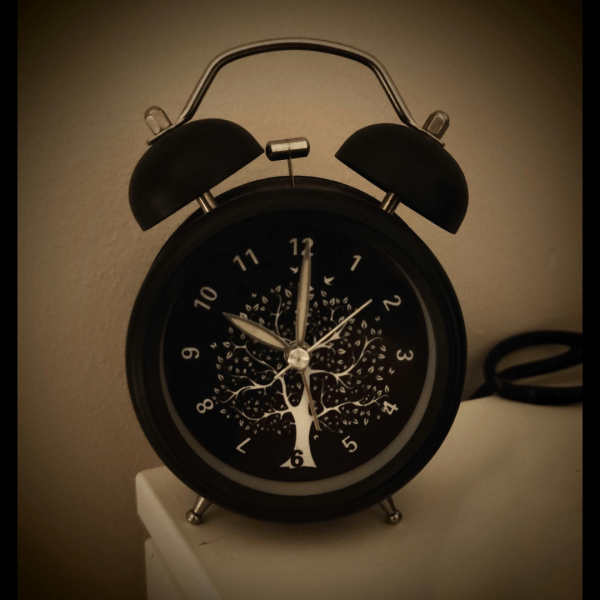
The alarm clock in the photo is the loudest thing in the world. In fact, it likely raises the dead, but I live too close to the graveyard to dare have a peek through the curtains just after the alarm’s gone off. It really is everything louder than everything else. Motörhead.

You might be wondering by now, if these are the ramblings of a woman gone completely bonkers. That my brain has become the dish that ran away with the spoon. (Mystery link!) I don’t know what to tell you – it’s just one of those days where I found myself shouting at my phone to ‘shut the fuck up’ over and over until it stopped ringing, rather than just hanging up. Surely, that happens to all of us, right?

If I’m the only one, please, feel free to have a chuckle on my behalf. I’m sure it looked and sounded pretty funny to the recently undead that were kicking about in the garden at the time. (Alarm clock, remember?). The thing is, it’s just stress. And the more stressed I get, the foggier my brain. I woke up mid-vomit this morning, terrified of having overslept. All I can say is, thank fuck no one’s here to witness it all.

What can possible be so stressful that it makes me throw up in my sleep, you might ask? Life, my friend. Life is stressful. And, had I just dealt with the one thing that kept getting in the way of everything else when I first noticed the pattern, I may have been able to avert the chaos. Instead, I left it to fester, and now even the slightest inconvenience (accidentally placing the loo roll the wrong way around, anyone?) will throw me off my already weakened game. Which brings us back to time.

Time wasted on avoiding the menial tasks on my to-do list by starting new projects. Time wasted on negative self-talk due to having begun said projects. Time wasted on being annoyed with shit that’s beyond my control. Who wants to control everything anyway? Because, ultimately, attempting to control something or someone is a futile gesture indeed. The only thing you can control is your own perspective, if that. But my perspective is bound to be tinted by my past experiences, my situation or my expectations. What caused me to view X as Y, et cetera. There’s no control.

If you want to get into the metaphysics of causation, you can head over to the Stanford University Philosophy Encyclopaedia and have a gander.

People are so hung up on who’s to blame for something, but they’d rather spend time discussing the big, horrible thing than actually doing something about it. Because, if the scapegoat goes away… how will they know for certain that they wouldn’t get the blame themselves the next time?

And I’m now wasting precious time thinking about what I want to write about next week. All I can tell you is that it’ll likely be a little more structured than this. But certainly not rant free! You’ve been warned.

Pending finally being able to manage the 15(!) remaining pages of the book that’s been eating away at my sanity since mid-November, I shall see you next Tuesday!

Until then, buy my book, or perhaps give me a shout via the contact form. Like Arnold used to say in his Pump Club podcast: “I want to hear from you”.

Efficiency suffers in wake of covid chaos

It’s finally happened. The movers and the shakers, the doers, of this world have all been diagnosed with an array of neurodevelopmental disorders, leading to unavoidable burnout due to the complete exhaustion that comes with being forced to do fuck all but contemplate your own navel, ultimately leaving the world unattended for just about long enough for the meek to think they’ve inherited the earth.

The result? Well, take a second to look around you. You’ll either see a sea of zombies with their heads bent at an awkward angle, trying to make sense of millions of pixels forming ridiculous – artificially generated and based on the cookies they’ve let crumble all over their digital existence – shapes on a magnetic screen lit by sickly blue to keep them from ever having a restful night’s sleep ever again… Or worse, you’ll accidentally subject yourself to the news.

Right, that’s enough of the doomsday pish. But, sadly, I don’t think I’m too far off. We’ve become oh so self-absorbed. People seem to think it’s morally acceptable to apply for a job whilst filled to the brim with a self-inflicted parasite, fully intending on going on maternity leave within three months of being offered the position – a position that ideally should have been awarded someone with a work ethic, had the recruiting party had even one iota of business acumen. They’re eliminating any chance of progress – it’s the opposite of a sustainable solution.

Once upon a time, human beings were capable of original thought and problem solution, enough to justify some degree of autonomy. Today, we’re on the precipice of social alienation due to an increasingly dangerous heteronomy. Go read some of what Science Direct wrote on the subject if you haven’t already.

Or you could study the collective works of philosophers Marx, Hegel and Kant. Or perhaps the works of this philosopher will be more to your liking?

I’d argue that the lack of empathy, the minimal importance your work has in your life and the general beigeness of society that the new omni-Deus/lord panic has invoked is alienating us further and further from anything other than apocalyptic apathy with every insincere ‘we’ uttered.

We, the people, are unequivocally fucked. Unless we wake the fuck up.

That’s it for today. Bleak, I know. If the world is still turning a week from now, I shall see you next Tuesday. Meanwhile, you should listen to this absolute gem from one of my favourite bands of all time; Flotsam and Jetsam.

The unavoidable convergence of kindred energies

In the not too distant past, I said I’d write something about friendship. But then life happened and the flames died down, leaving nothing but an ember behind. Well, the wait is over, because someone stoked the fire into a mighty roar!

If you manage to read through the whole thing, I’ll include the very words that inspired me at the bottom of this page.

All my life, I’ve flitted from loner to loner like a very busy little people-pleasing bee, trying to find matches for those who seek me out. Not bothering to seek out people I’d consider a good match for myself, of course, because that’s far too scary. (Also, I never planned on being around for very long in the first place, so why bother).

Regardless.

I wound up becoming everyone’s pal and confidante, but without having any real pals of my own. And with my constant need to be everyone’s best friend, I was ultimately an unpaid agony aunt-cum-matchmaker.

(Boo-hoo, poor me! Relax, it’s not that kind of post). But, if you’re in the mood for something a little darker, head on over to another one of my posts here, or buy my book.

I did get to a point, though, where I’d had it with the upkeep of these one-sided, fair-weather friendships, and I’d have to move far away and/or burn all bridges as thoroughly as humanly possible. As it turns out, you simply cannot rid yourself of a real pal that way.

I’ve known my very best friend for 30 years, and it’s the most effortless human relationship I’ve ever had. That’s not to say that we don’t go all in for each other when needs be – because we do – but it doesn’t feel like work. I know she doesn’t expect anything from me, and vice versa. We’re not afraid to say what we mean to each other, because there’s an unconditional love tying us together. She’s been there for me through some really horrible shit, and she’s still there – she must be nuts. But she’s my nutter.

The interesting thing here, though, is that we’ve lived hundreds of miles apart for the better part of those 30 years. For the longest time, I suspected this physical distance to be the only reason anyone would ever stay friends with me for any longer than a few boozy hours down the pub. These days, however, I’ve realised that’s not the case.

The pandemic probably helped change my mindset as well. In Edinburgh, we didn’t really have the opportunity to socialise the way we used to- at least not face-to-face – so if you did reach out to someone, it was out of a genuine wish to interact with that particular friend. And even now, as I live miles and miles away from my home, these guys are the ones I speak to more regularly than the people sat next to me in the office every day. And, as it turns out (with one or two exceptions in my geographical proximity), the friends I’ve made that are scattered all over the globe, are the ones I consider my closest.

What might have started out as a need to protect myself from the potential hurt of losing a friend has ended up being a sort of confirmation that I am worthy of being someone they’d want to keep in their lives. And the other way around.

Apparently, there’s something about ADHD and challenges with adult friendships worth researching, but I think all adult friendships require something more. They need to challenge you, to sustain you, to elevate you and keep you grounded, to enable you to see your own story from a different perspective when you’re stuck in a downward spiral (or a narcissistic doom loop, for that matter), and you need to be that for someone else as well.

My plan was to research this properly, because I came across a podcast episode on this. Not just one, to be fair. There are hundreds. But this one seemed like the real deal. I’ve yet to listen to it, so I’ll share the link below so we can all listen to it together.

And, as promised, I will now share the inspirational words of Mr. B (with his permission, of course). This, to me, is what friendship is all about. I consider myself to be very fortunate to have been on the receiving end of these words:

I share with you the strive to do better, to be better

I share self-loathing and self-sabotage

I share self awareness.

I share distrust of others.

I share utter devotion to the (very) few.

See you next Tuesday. Drop me an email if you have a topic you’d like me to write about!

Creative differences

If you consider yourself to be a creative person, I am willing to bet you have also found yourself staring so deep into the abyss on enough occasions to either having sat across from a mental health professional at some point in your life, or someone has pointed out to you that maybe that would be a good idea. Regardless, you’ve had a chance to consider whether or not medication is for you. And many of us tend to opt out. We’d rather live with crippling depression, biweekly panic attacks, compulsions and partner-repelling mood swings than potentially lose the one thing that makes our existence make sense; our creativity.

Let me just pause for a second to let you know that I am aware that this is a myth that’s been thoroughly busted. You can read about this and other SSRI related myths by clicking on this sentence.

Still, it’s a very real fear that needs to be acknowledged. If you cannot fathom why, this post is not for you. Go read something else. I can recommend my book. Or, if you have yet to listen to Rob Halford’s autobiography on Audible, you should go do that. It is fantastic.

If you do know what I’m talking about, though, you’d be very interested in what I heard in a podcast I listened to recently… What we (us mental patients of the neuro-spicy kind) mean by creativity in this scenario is not necessarily how it’s perceived by the people prescribing the meds. On the contrary, when we state our fear of losing our creativity as the main reason were so sceptical, they seem to think our meaning is that we’re afraid we’ll lose the ability to think outside the box. I.e. they think that, by creativity, we mean creative thinking, in regards to problem solving.

Whereas most of us mean the ability to create something unique, freely and without template, fuelled only by an inner compulsion to create. Essentially, its our life force; what makes us us.

Perhaps we should’ve used the word imagination instead. But, it’s not on us. As defined in most thesauruses and dictionaries, creativity is “artistic or intellectual inventiveness”. Yet, in a post found on Psychology Today, we see another example of the writer seemingly focussing on the problem solving aspect rather than the imaginative.

I would be remiss if I’d concluded that all mental health professionals are of the same opinion as this single writer and the neurologist from the podcast, but I do think that it’s worth noting that the person being prescribed the medication might not be equally as immersed in the DSM diagnostics sociolect as the person holding the prescription pad.

It is a myth, though. SSRIs or ADHD meds won’t kill your creative ability (although some SSRIs may cause brainfog, but most ADHDers experience that regardless).

Some lyricists may fear that they can only truly write when they’re depressed, because that’s when they’re the most connected to their emotions or whatever. That’s a load of bollocks. You can certainly learn from depressive episodes, but being depressed isn’t going to make you the next Bob Dylan – if that were the case, you could get the same effect from downing a bottle of red. If you’re really talented, though, you don’t need any of that shit – the talent is part of your personality. And, as far as I know, they have yet to make any FDA approved personality altering drug.

There are logical solutions to creative blocks as well – we’re just too impatient to admit it.

That’s it for today. I reckon my next pist might be real morbid. (Or I might go down a panic attack related wormhole, full gonzo).

Either way, see you next Tuesday!

Also, the featured photo is of one of my favourite paintings, ever, found in the Voodoo Museum in New Orleans (quite possibly a Voodoo Charlie original). If you’re ever down NOLA way, you should check it out.

Grievances from a shallow grave

I never quite managed to tell The Tell-tale Heart and Death of a Salesman apart – or the latter from Fiddler on the Roof, for that matter – I was so bored out of my skull from all the pretentiousness that I somehow blocked out the differences. I’d rather read The Salesman Fiddler Tell-all (Death on the Roof). (I mean, who wouldn’t?)

What’s this got to do with the price of moth-eaten stockings? Well. All three of the aforementioned works of fiction (one would assume) are quite dark. And being introduced to them during my hormone-infested formative years, when I was already submerged in thoughts about the frailty of the human body, they all seemed to embody the same message; death will come for us all. I suspect that’s when I first decided that I wasn’t going to let death take me by surprise – I was going out on my own terms.

And, thus, my fear of death was born. Much thanks to the flawed human psyche. I wanted to finish myself off. I had made my peace with dying, but I had a few things to tick off my list before I could escort myself off the ledge, as it were. I didn’t dare to sleep, in sheer fear of never waking up again. (Which eventually resulted in fainting from the exhaustion, but you’d be surprised at just how long a stubborn child can manage to stay awake if left to their own angst-ridden devices). Thanatophobia, for you learned folks.

I know I promised you a post about suicide and friendship, but I changed my mind. And then, as I was running through a graveyard to catch a bus yesterday, I started thinking about the link between death anxiety and suicidal ideation – surely there must be one. But now I cannot find any research on the matter, so I am hoping this finds its way to a person in the position to do a proper study on it. In the meantime, you can read about “Attempted suicide and Death Anxiety” on the American National Library of Medicine. It was the only thing slightly scientific, not in a Reddit thread.

And instead, I will give you my two cents on how forced time off work/paid seasonal leave can lead to burnout if you have fallen out of love with your job. I’m not talking about going away on holiday here, I am talking about being faced with whole days completely without team meetings, work calls, the constant need to check your phone for notifications and the endless to-do-lists, and you haven’t had to ask for it.

Most people will enjoy the time off, fill it with family activities, festive pish, a Tinder-palooza if so inclined, and some might feel a bit anxious about not being able to respond to emails, or they didn’t manage to get everything done before they left the office on the last day, but even those people will be able to relax after a few days have gone by without any disasters. And, depending of just how many days one is awarded off, some of these people might start to notice how their sleep pattern improves. Some might notice a slight weight loss, their complexion clears up, all of a sudden, it’s been a full week without them reaching for a single Paracetamol. But they might think very little of it – they might even brush it off as them finally starting to get over that cold that somehow came over them mid-October and never quite left.

But then, as if by magic (or, rather, a curse), the last day of the holiday arrives and they unable to fall asleep, because they’re terrified the alarm won’t wake them, so they pass out some time around 1am, only to wake up in a pool of sweat two hours later, which then has them twisting and turning until about 40 minutes before the alarm’s set to go off, when they finally fall asleep. One alarm and five snoozes later, they’re standing in front of the bathroom mirror, wondering what has happened to the person looking back at them the day before, when they hadn’t even needed an alarm to get them out of bed by 6. The week is off to a shitty start, and when they get to the office, they are inundated by emails they are unable to respond to, because of the incessant post-hols chatter between the more cheerful colleagues, who have been looking forward to seeing everyone again (and no doubt get to see a little less of their respective families). So, little by little, the sleep-deprived shell of a human being just sits there, staring into their computer screen(s) looking for the meaning of life, as the first headache starts to brew, accompanied by a fever and a slightly elevated heartrate from the stress. This, of course, is followed by nausea, but at the same time they are overcome by a seemingly insatiable hunger – they can feel their body expanding just at the thought of food… If this is you? I have one word for you; burnout.

We don’t talk enough about the physical symptoms of burnout, or the detrimental effect it can have on our everyday. There is a chance that a change of scenery can fix it, but, regardless, you can benefit greatly from seeing your GP about this. Just talking about it with a professional can be a tremendous help. This is your body screaming at you to stop what you’re doing and tend to it before it shrivels up and dies a slow, painful death. Or, if you’re just dying to leave a cortisol-filled middle-aged corpse behind, continue ignoring it.

If the prospect of going to work feels like a fate worse than death and fills you with dread – or worse, with indifference – you might want to update your LinkedIn profile…

I leave you today, with the immortal words from Clare Harner’s 1934 poem Immortality, as published in the December issue of poetry magazine The Gypsy:

Do not stand
          By my grave, and weep.
     I am not there,
          I do not sleep —
I am the thousand winds that blow
I am the diamond glints in snow
I am the sunlight on ripened grain,
I am the gentle, autumn rain.
As you awake with morning’s hush,
I am the swift, up-flinging rush
Of quiet birds in circling flight,
I am the day transcending night.
     Do not stand
          By my grave, and cry—
     I am not there,
          I did not die.

Because, I am not there. I did not die. I just listened to my body and managed to get myself pulled out of the abyss before I was buried alive. Now, go buy my book, please. Or, you could send me a wee message! See you next Tuesday.

Why you should say f*ck off to faking it

Today, I’ll start by giving you a choice; you can see this post as the trivial, banal waffle of a fortysomething spinster, or as a welcome distraction to the soon to be if not already 3rd world war currently monopolising every news broadcast out there. Regardless of your choice, please be aware that I will now be diving straight into a rant, in an attempt to escape the harsher realities of my own existence.

If you’d like something more palatable, I suggest you go watch this episode of Banana Man on YouTube – you can do so by clicking anywhere on this sentence. It is quite delightful. Also, made by actual human beings using their actual minds. Even the voices are real.

Or you can pass START without collecting 100 dollars and instead spend a fiver supporting the poor by clicking on this one.

Don’t say I didn’t warn you.

We’ve all heard the phrase ‘fake it until you make it’, but as dishonest as such an approach may be – at least it used to come from a place of needing to accomplish something (and more often than not, the fakery came with a valuable learning experience or two). With the rise of AI, however, the faking has become the norm, and what’s more, no one seems to see the need to learn anything, even when it comes to developing a personality. What was initially designed to be a helpful tool to help develop ideas has become the thing that surely will eradicate both art and empathy in modern society. I’m not presenting this as fact, but I’d say it’s a rational fear at the very least. By faking your way through life using nowt but shortcuts and with no desire to add to your skillset, you’re not only lying to the people that have to suffer through your incompetence – you’re lying to yourself. It’s the ultimate injustice. And if there’s one thing I’ve learned about myself (and that this is a common trait for neurodivergent folks), it’s that I cannot stand injustice. Thus, there is no way that faking it to get ahead is the best solution for us.

To those who still don’t get it, I ask you this; what will you do once you reach the proverbial top? You’ve faked your way there and learned fuck all along the way. How the hell do you expect to carry on the charade?

I have chosen this particular topic, as I keep finding myself in positions where I am meant to pick up the ball from where one of these fakers left it, with no trace of them having done any actual work. In one such scenario, I kept asking for an overview of the processes and tasks I was to become responsible for in their absence, and was (after almost a month) presented with a list of links and a Word document with instructions for using software in which I am already proficient. Me being me, I thought I shouldn’t knock it before trying – maybe they had a better way of doing things – but I soon found myself stumped by the inaccuracy of the instructions. So, of course I asked them to clarify. (I’ve been wrong enough times in my life to know better than pretending to get it…). At which they simply replied; ‘oh, it’s easy, I just asked ChatGPT and jotted down the response for you’. No wonder the ‘quick fix’ tips did fuck all!

At least, with a paid version AI, you can get some decent guidelines, but you should probably run a few tests before listing them in an on-boarding document, eh? Also, I’d much rather do a non-assisted search to find three credible sources and take it from there, instead of having to fact-check anything generated by artificial intelligence.

I know I could’ve let this go – perhaps even should’ve, but I ended up wasting so much of my time trying to make use of the so-called instructions (and doubting myself) that I just couldn’t. It would have been better to just crack on the way I always do, and to revise my textbooks and course videos if and when I’d get stuck.

Over the past few years, I’ve seen so much of this and I’ve had enough. Why should people like me get punished for wanting to do the work and, for instance, writing my own CV and cover letter, when fakers, who’d rather sit all day and chat about what colour they’re going to paint the nursery than doing any actual work, get all the jobs they apply for because they don’t bother fact-checking the lies the AI bot has produced by creating a text out of their poorly worded bullet points? GAH.

Hear me when I say that I am quite irate. You’ve poked the bear one too many times. And this is much, much bigger than me being annoyed at lazy fakers.

Imagine, if you will, that something truly horrible happened to you – a crippling illness, or you were wrongfully accused and incarcerated for murder – would you trust a doctor or a public defender that “got “earned” their qualifications by taking shortcuts? Or, if all of the pipes in your house suddenly burst and needed replacing in the middle of winter, would you trust yourself or a partner using AI and YouTube videos to fix it over a certified plumber?

I certainly hope not.

So, what’s this to do with mental health? I hear you ask. Everything, I say.

Initially, I’d left myself a note to write and research how faking it rarely works for those with ADHD and a side of rejection and/or justice sensitivity. You can read more about this in Amelia Kelley (PhD)’s article on Psychology Today: How justice sensitivity amplifies world issues for ADHD.

I didn’t realise this was a thing until I got diagnosed – I’d just always thought I had a strong sense of justice. This helped explain a few things, but mostly why it felt so unnatural and just wrong for me to be faking anything. It’s like lying to yourself, and our need for justice will help our subconscious see through the lies, so we’ll end up feeling as if we’ve effectively tried to pull one over on ourselves. It’s like masking, but when we really don’t have to – or even should. (One could argue that you should never try to hide who you really are, but hey).

Which brings me to the scary, and most of all really quite harmful, side effect of masking: SKILL REGRESSION; defined on Psychology Today as “behavioural “backtracking” or reversion to earlier coping mechanisms that can occur as people progress through different stages of development”.

This was explained in much simpler terms in a podcast episode I listened to the other day (link at the very end of this post), as the regression of skills you learned while masking. Once you get treated for your symptoms and no longer need to mask, some of these skills may even need to be relearned and new neural pathways need to be constructed to help locate the seemingly forgotten skill. (Thank fuck for neuroplasticity, eh?). I wonder if this works for repressed memories as well. Who knows.

Anyway, I am at the end of my rope here and I need to get ready for work. I promised you a link, so enjoy this episode of Hypercast by clicking on the Spotify link below.

See you next Tuesday! There may or may not be a post on suicide recovery and friendship. Stay tuned.

Finding calm with a busy brain

I took this photo at a gig this weekend, just as the shutter on my camera stopped working properly – hence the blur. Not a great thing to have happen mid-show. Alas, when I was going through the hundreds of images I had uploaded from my trusty Canon onto my desktop in the hope of finding something usable, my heart jumped a little at this particular photo. THIS is what my brain feels like when I’m told to be quiet or to sit still for any undisclosed length of time. It might resemble noise pollution to most, but, to me, it is more akin to an everchanging tapestry of neurons firing and processor overload.

If you, like me, have a slightly over-active mind, where there’s no end to the constant chatter going on behind your eyes, you may have been guilty of rolling your eyes so hard at the mention of the word ‘meditation’ that you’ve given yourself a headache on more than one occasion. Like trying to silence the voices in your head whilst sitting completely still for who knows how long is going to be anything other than a gigantic waste of time. Because, as we all know, this is how it works; the road to enlightenment/serenity is awarded only those who can shut down completely, sit in a lotus position for hours on end, breathe in and out in a pattern of inhalation for four seconds, hold for four, exhale for seven, without getting caught up in the counting, stop thinking about anything other than roots springing out of your arse and into the centre of mother earth (and also avoiding thinking resentful thoughts brought on by the word mother), be oblivious to the fact that the earth’s centre is filled with lava that will surely burn your rectal roots and not ground them, all the while trying to keep your eyes closed and not check the time every five seconds, to make sure you’ve counted your breathing seconds correctly. WRONG!

This might be how traditional meditation has been presented to most of us through books, films, YouTube channels and podcasts, and “everyone” all claim that meditation is “great” for people with ADHD, but no one’s ever bothered to tell us why it’s so great, shared with us the philosophy behind it, or let us know that there aren’t really any rules to how you should meditate. Turns out, you don’t even need to keep your eyes closed!

If you started reading this under the misapprehension that it would be another well-researched post filled with interesting links, I apologise. I’ve been under so much stress lately that I’ve been searching rather desperately for anything that could help, so when I came across this random podcast episode where they were discussing ADHD and meditation, I didn’t remember to bookmark it for later. (Very clever, I know). But the general gist of it, I remember, because the host and their guest confirmed something that I have been theorising for quite some time; that meditation can be relative to the person doing the meditation.

Let me explain for a second: I find running meditative, especially when I go hard enough that my body becomes so tired that I can no longer stop my thoughts from flowing freely, which in turn brings forth many a solution to any conundrums I have had in the past. If I need to sort something out, that I can’t get my head around, or have an impossible deadline and keep procrastinating, I go for a long run, aiming for a PB. That works for me. I’ve tried sooooo many guided meditations, both live and to recordings, and all they do is stress me out. There’s too many rules! And how am I meant to find inner peace when people keep breathing, or the so-called guide keeps mispronouncing certain words or saying nonsensical things? Why can’t they just shut the fuck up so I can collect my thoughts for a second? Oh, I’m meant to “empty my mind and let go of what no longer serves me”. Right. How about giving me a goddamned second to think about what that might be? Oh, we’re manifesting now. Okay. What the fuck? I need to do things my way.

Needless to say, I was more than relieved when I heard the aforementioned episode, because – like many others with ADHD – I need confirmation on certain things. I need to know I’m doing things correctly. (It’s a miracle that I ever manage to walk anywhere without overthinking my every step, because no one has ever confirmed that I’m following the foot placement recipe correctly).

So, I thought I’d share this with whoever else out there needs it. It gave me some piece of mind and I am allowing myself to stop torturing myself with the biweekly guided meditation pod I’ve been following for the past three years. That’s more than 39 hours of time wasted… but it could have become a lot more had I not realised that I can meditate in the way that I see fit.

So, what is the purpose of meditation? I like what I found on study.com: “Meditation is an act of connecting the mind and body to the present moment.”

They also list seven different types of meditation, in which we find ‘movement meditation’. I feel like so many have focussed on the relaxation aspect of mindfulness meditation, that it’s become ingrained in our culture that we need to be half-asleep in order to connect with our truth. There is something to be said for the breath work in meditation, of course, but I don’t necessarily think that you would have to follow a pattern set by someone else. Do you have someone set the temperature for your shower as well? I certainly hope not. It can of course be helpful to have a look at different techniques and what works best for which type of meditation, but at the end of the day, your meditation practice needs to work for you. It’s precious alone time for you and your brain – even the busier kind!

To finalise, this is a time of year when there’s more unwanted noise coming from every angle than normal. Perhaps we can find a way to turn all that food noise, money noise, people noise into background noise by finding a small pocket of alone time in a day. Just five minute can be enough, this podcast told me – that’s less than an average poo!

And on that note, I bid you farewell for the last time in 2025. See you next Tuesday!

Oh – please buy my book. I am very poor and in need of a new camera.

Perhaps I’ll kick the new year off with an interview with an up and coming band from Norway’s metal scene… Keep your peepers peeled!

HAPPY NEW YEAR, MAY THE NEW ONE BE A BIT LESS SHIT.

Wee update! I found a great article on ADDitude.com, where they provide a detailed account of how you can make meditation part of your daily routine without too much hassle. Click anywhere on this sentence to read. Cheers!

Ever bite off more than you could chew?

There’s something special about those first few movies you watch when you’re a little too young. When your mind is still blissfully unaware by the horrors of human nature, your eyes still able to close without the back of your eyelids instantly transforming into screens displaying your innermost fears. No matter the content of these films, and perhaps especially when you don’t yet possess the knowledge to fully comprehend them, they have a way of staying with you for a long time – maybe forever. More often than not, they become a handy source for icebreaking fun-facts. My go-to (and also a great way to find the best weirdos at a party):

Did you know that, if you ever find yourself in a situation where you have to choose between starving to death and eating one of your friends, you should start with the one with the strongest looking glutes?

Yeah, I was ten when Alive came out. It had Ethan Hawke in it – of course I had to watch it! Although I’m not sure how I can defend my obsession with the bloke in Bon Jovi’s Always music video, who also features in the film quite heavily, as that didn’t come out until the year after. Regardless, if you’re planning on getting stranded on a desert island with me, you’d better lay off the Booty Builder.

I am, of course, talking about cannibalism.

Cannibalism, the consumption of another of one’s own species, is not uncommon. A lot of animals and insects do this – in some cases, it’s even part of their mating ritual. Human cannibalism, however, is not so common (and rather frowned upon in most cultures). Even so, a few fictional anthropophagists have become rather popular on the silver screen, such as Hannibal Lecter, Baba Yaga, the Gingerbread Witch (of Brothers Grimm fame). Then there are those, such as the rugby team from the aforementioned 1993 based-on-a-true-story movie, that have been forced to become nutritional cannibals in order to survive. There are several types of human types of cannibalism, of course, like the necro kind, when you eat the already dead, and homicidal cannibalism, where a human kills another human for the beef (one would assume, the arse), i.e. culinary exploits. Regardless, this is not an episode of The Beef and Dairy Network, so I will leave any details for the experts.

There are also quite a few expeditions, such as the ill-fated Franklin expedition of 1845, where there’s evidence of the explorers having indulged in nutritional cannibalism. Whether or not the eaters waited for their meals to perish of natural causes remains a mystery, but there’s something about the whole thing that, to me, seems a little sinister.

Cannibalism has been known to be part of funeral rites in some cultures. In others, human sacrificed have been made and then eaten. I can sort of understand the cultural cannibalism. It seems practical. But to just sit down and decide to eat someone you’ve planned a trip with? That’s some different level stuff. Anyway, there’s an article on this on Britannica that does a nice deep-dive into this, so read it if you’re thinking yolo when it comes to your search history.

Why did I choose this particular subject, you ask? Well, I was re-watching the rather fantastic Buffy the Vampire Slayer movie the other day (gee whiz, what a cast, by the way!!!), and got to thinking about vampires. But in the buffyverse, vampires are not human – they are demons. And they don’t eat people, they only drain them of haemoglobin… but it still got me thinking that I might be able to find something new and intriguing in my research. Alas, the coolest fact I possess is still the arse one from Alive.

It is mega late, so I will leave you to it. There’s no antropophagy in my book, but there is an event or two that might make you want to put it in the freezer for a couple of days before you keep reading – you can buy it here.

See you next Tuesday, when I will tell you about my theory on why faking it ’til you make it can be especially difficult for those with ADHD. Until then, go watch the Buffy movie – it has Paul Reubens AND Rutger Hauer in it!

Scandi Christmas; from bloodletting to hygge in 7 minutes

Gather ’round your tablets and let me tell you the tale of how scaring a nation of Odin-worshipping farmers and warriors into believers of a bastard child saviour from faraway lands ended up tarting up the winter solstice celebrations, but first, yule probably want me to explain what the hell I am on about… Ha.

Firstly, massive thanks to those who replied to my desperate cry for inspirational input on the socials! It was a close call. However, faced with the choice between writing about cannibalism and yule and solstice, I opted for the latter. Cheers, Durand!

I might save cannibalism for next week, for those seeking alternatives to the traditional Christmas dinner – I bet the calorie density of a human arse is less than that of a serving of crimbo pudding alone. Not that I’d recommend eating either of those, of course.

Interestingly enough, the parents of the Icelandic Yule lads actually did eat human children (presumably fictional lads and children), but that’s neither here nor there, as I don’t know if we can safely assume that a troll is a humanoid creature and, as we all know, cannibalism refers to humans eating other humans.

Right, let’s dive into this.

The Norwegian, Swedish and Danish word for Christmas is ‘jul’. This we can all agree on. In Icelandic, it’s ‘jól’. Yule in ye olde English. It originally stems from the name of the heathen winter solstice celebration; jólablót. ‘Blot’ is the sacrificial spilling of blood of an animal or human. I didn’t really have to do much research on the etymology, as I grew up in the place that saw the last ‘blót’ with a human sacrifice in Norway – heads of the Norse gods they worshipped are to this day displayed inside the church that now sits in the place where they used to perform the blót, with human blood so ingrained in them that it is still visible if you study them up close. Gross. And weird. Like most organised religion, I suppose. I digress.

Anyway, you can read about Mære kyrkje in the Snorri saga Heimskringla, if this has tickled your fancy. Me, I had to translate Heimskringla from Old Norse to Norwegian about 20 years ago and have had my fill. Here’s an article about how king Olaf the Holy beat the heathen king Olve, in Norwegian. Now, if you’re in the market for a far more interesting person of the same name, you can check out the split album True Kings of Norway, by clicking anywhere on this sentence.

So, how did they go from blood sacrifice to carolling and decorating their homes with stars, paper hearts, deformed versions of Santa and his family members and bloody angels?!

Etymologically, jul/yule/jól is believed to be Proto-Germanic, whichever way you spell it. Perhaps we can blame the raping/pillaging vikings for this, perhaps not. Regardless, it is the name of a heathen winter festival that was held either on the winter solstice (the shortest day of the year, leading into longer days and brighter times), or over the course of three days surrounding midwinter night. It appears historians cannot agree on this. My take is that some historians take what’s written in the Snorri Sturlasson sagas as historical facts, whereas others do not. What they can agree on, however, is that it was a heathen festival that has somehow “merged” with Christianity during the Christianisation of Scandinavia between year 900 and 1200.

It also appears most online sources do not know the difference between paganism and heathenry, thus use the terms as if they are interchangeable, so let us just, once and for all, clear this up: They are not. Ha. You can Google this until your heart’s content, I’m not getting into it today. But what we do know is that the Scandinavian yule traditions predate Christianity and its celebration of the birth of Christ.

What sort of traditions are we talking about here? Well, like most other nations, the Scandinavian countries have as many different variations of traditions as there are families. Norway, Sweden and Finland are all fairly lengthy from the south to the north, and narrower in the middle – the climate varies vastly. This has always affected – and continues to affect – diet, fashion choices, political views, infrastructure… you name it. So, just food-wise, Bergen residents do not have the same jule-meal as people in, say, Lillehammer. I’m inclined to think this was the case in the olden days as well.

Anyway, back to yule. (To me, to yule). The celebration of the winter solstice was in many ways a ritual that marked the beginning of the end of the darker period of the year. A feast with the best produce stored from the last autumn harvest, along with cooking up an animal sacrifice made to the gods to secure a good spring, brought the community together. Seeing as it was likely freezing and the microwave was yet to be invented, you can imagine they had to set fire to some of the foodstuffs to avoid the need for a dentist (which, spoiler alert, didn’t exist yet either), which has carried over into the Christmas pudding booze volcano tradition. I do not know of any Scandinavians that are setting fire to their Christmas dinners these days, but judging by what they eat, perhaps they should.

Any gifts were for the gods. The incessant gift-giving came with the three “wise” men of Biblical fame. There might have been the odd wreath, handmade candles or a stray straw yule goat here or there, but the decorations we see today are far from traditional and not so much linked to superstition.

The aforementioned cannibalistic yule lads of Iceland do have some similarities with the Scandinavian nisse (not to be confused with the modern day ‘julenisse’, Saint Nick/Santa Claus); nefarious barn dwellers that were after livestock, punishing naughty children and play pranks on farmers who hadn’t managed to get their shit together before the solstice. Not too different from Krampus, but smaller in size, magical and with no coal for your stocking. An evil hobgoblin dressed in red, if you may.

The nefarious creatures and superstitious decorating likely stems from needing to protect their produce and cured foodstuffs from prying eyes (and mouths) before they were ready. No wonder they were made to look like horrible little trolls. Additionally, the often long and hard winters could take their toll on just about anyone. With no medical knowledge or ways to predict logical weather patterns, superstitions such as warding off evil spirits with a wreath or a goat helped people pull through the tough times. And for those who didn’t, it was fairly easy to blame it on not having completed the seasonal rituals in time.

To finalise, the winter solstice represented a positive turn – a way out of the darkness. This was marked by a feast, with an animal sacrifice and and rituals to celebrate the gifts received from the gods in the past year, something I believe was fairly widespread in pre-Christian times. The lack of reading and writing skills around the days where Christianity thrust itself onto most any unsuspecting nation might help explain why there are so many different versions of what might have actually happened and just how the traditions merged – I suspect most people just shrugged and said ‘ I guess we’re Christians now, eh’ and got back to the grind, not really caring if they mixed a little bloodletting in with their Sunday mass.

I might investigate this further, but if I continue now, I can feel myself getting into dangerous territory. Not today.

By the way, you might be interested to know some Satanist groups celebrate Yule around the same time as the Christian holiday is observed. Contrary to popular belief, though, with no worshipping of deities of any kind. Satanists are secular hedonists – not stupid.

So, to end this on an even happier, ding-dong-merrily-on-high, note, I wish you a pleasant rest of your day, now that you’re armed with some fun new facts to dazzle your co-workers with. If you find yourself surrounded by just too many £20 notes, you can always get yourself a copy of my book – hell, even FOUR of the E-book. See you next Tuesday!
Blog at WordPress.com.

Up ↑